Stedham Common

Meeting date: 5 May 2022
(Leader: Nick Sturt)
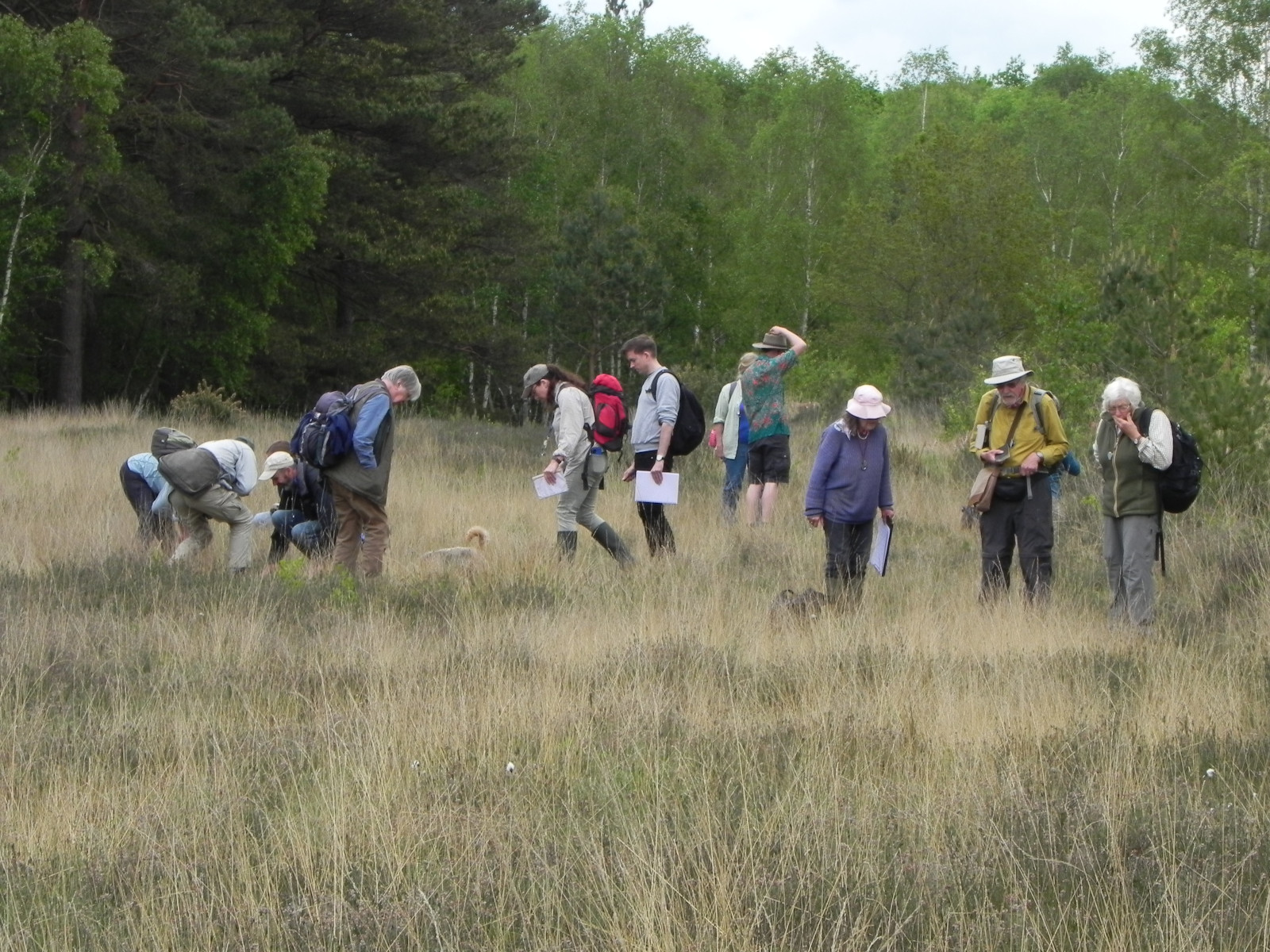
Fifteen members and a small dog met at Iping Car Park, near Midhurst, for an exploration of the acid lowland heath of the SWT reserve at Stedham Common. We crossed the road to explore the more northerly of the two tetrads, SU80L, before exploring SU80K. Within moments, the group fell to their feet to examine the abundant Luzulas and consider the possibilities of Luzula campestris (Field Wood-rush), and the subspecies of L. multiflora (Heath Wood-rush), ssp. multiflora and ssp. congesta. Key examination of the anther/filament ratio suggested ssp. multiflora; we found ssp. congesta later.
The usual woodland species were found, also an unexpected Silene flos-cuculi (Ragged-robin) in dry conditions by the woodland path. Emerging onto the heath, Ulex europaeus (Gorse) and U. minor (Dwarf Gorse) grew side by side, allowing a comparison of jizz and flowering state. Some puzzled over a Malus – crab or not, eventually thought to be too hairy for M. sylvestris (Crab Apple). Several square metres of Stellaria alsine (Bog Stitchwort) bloomed in the footpath. Other highlights included a variety of sedges: Carex pilulifera (Pill Sedge), C. caryophyllea (Spring Sedge), the former with inflorescences arching down, the latter upright. Also we found C. hirta (Hairy Sedge) and counted the three stigmas of C. binervis (Green-ribbed Sedge). We lunched sitting on a chamomile lawn with a garnish of Ornithopus perpusillus (Bird’s-foot) in flower, by a carved dragonfly stone bench, one of the Serpent Trail sculptures. We inspected the most easterly documented Agrostis curtisii (Bristle Bent), a few tiny tufts, and found Cuscuta epithymum (Dodder). Exploring the boggier areas we found Polygala serpyllifolia (Heath Milkwort) and Trichophorum germanicum (Common Deergrass). There were drifts of both multi-headed Eriophorum angustifolium (Common Cottongrass), and the single headed Eriophorum vaginatum (Hare’s-tail Cottongrass). We found with great excitement some possible Eleocharis acicularis (Needle Spike-rush), though home inspection by our Chair showed it to be young T. germanicum. Lycopodiella inundata (Marsh Clubmoss) was in a nearby ditch. New member Eddie Baird identified owl pellets for our inspection, revealing leg bones, likely of a young rabbit, and identified a freshly emerged Four-spotted Chaser dragonfly.