
From a Bryum at Beachy Head: Charlotte Smith, Sussex and botany

[A talk delivered at the SBRS AGM 7 March 2020. Only a small number of the sources are given here; for a more comprehensive list of references see Clemit & Scott (2020)]
Charlotte Turner Smith was an eighteenth century poet, novelist and botanist who had a long association with Sussex. I first came across her while idly looking for references to moss genera in literature of the period via Literature Online; there I found the lines “Rude rocks with Filices and Bryums smile, / And wastes are gay with Thyme and Camomile” from one of her poems published in Beachy Head (1807). My curiosity engaged, I discovered that a huge amount of research on her has been undertaken in recent decades, including the publication of her collected letters (Stanton, 2003). I was therefore a bit surprised to find some unpublished letters in the collection of the Linnean Society, and have recently collaborated on some research on them with Pamela Clemit, the editor of the Godwin letters, and professor of English at Queen Mary, University of London (Clemit & Scott, 2020).
Though she is no longer as familiar to us as other poets of the period, Charlotte Smith is particularly notable in English literature as an early exponent of the Romantic sonnet. She met William Godwin, the young Wordsworth visited her in Brighton, and Jane Austen certainly read her extensively. However, she also had a troubled and difficult life, and moved many times as her circumstances changed. In natural history she is significant as one of the few women mentioned in English Botany (1790-1814) and who botanised in Sussex before 1830.
Born Charlotte Turner in London in 1749, her family had estates at Stoke Park in Surrey, and Bignor Park in Sussex. She went to school in Chichester and Kensington, and was taught drawing by the landscape painter George Smith. Often at Bignor, here she developed an interest in landscape, nature and the Downs. (The biographical information in this essay draws heavily on Fletcher, 1998.)
In 1765, shortly before her sixteenth birthday, she was married to Benjamin Smith, whose family were West India merchants. He was abusive and a spendthrift, and Charlotte later described her status as a “legal prostitute”. She had 12 children, though only six survived her.
Things got more complicated when her husband’s father died in 1776 leaving a very messy will which he drew up with no legal advice; it was aimed at providing for his grandchildren and avoiding his son, but was consequently tied up in the legal system for decades. Benjamin Smith became progressively more indebted and was in King’s Bench prison in 1783; Charlotte accompanied him, compiling her first volume of poetry Elegaic Sonnets to pay the debts. This turned out to be a very successful publication, going through numerous editions, each expanded with extra poems.
Many of these works include botanical references and are closely tied to the landscapes Charlotte knew well, among them a whole series of sonnets on the river Arun. At this stage the botany is rather broadly painted, as in sonnet XXXI “Written on Farm Wood, South Downs, May, 1784”:
- Spring’s dewy hand on this fair summit weaves
- The downy grass, with tufts of Alpine flow’rs,
- And shades the beechen slopes with tender leaves,
- And leads the shepherd to his upland bow’rs,
- Strewn with wild thyme
Its poetic use of “Alpine flow’rs” is of course some way off botanical reality, though Charlotte Smith adds a helpful endnote, demonstrating that the plants she has in mind are those that are still familiar to us on the Downs today: “An infinite variety of plants are found on these hills, particularly about this spot: many sorts of Orchis and Cistus [ie Helianthemum nummularium (Common Rock-rose)] of singular beauty, with several others.”
The following year Charlotte followed her husband to Normandy, though was soon back in Sussex, at Woolbeding House expanding Elegaic Sonnets.
In the eighteenth century married women didn’t have any legal right to own property independently. Consequently, it was a radical and shocking decision by Charlotte in 1787 to leave her husband and try to earn a living for herself and her children from her writing. This also resulted in her being forever on the move, living in various places in the south of England, though often gravitating back to Sussex. Benjamin Smith continued to claim what was legally his, occasionally turning up at Charlotte’s publishers demanding that he be given his wife’s earnings.
Over the next decade Charlotte worked constantly, writing about one novel a year, giving her success and the ability to (just about) keep afloat, all the while developing her botanical interests. Since the work of Linnaeus, his sexual system of classification had come to dominate approaches to this science; it was an artificial system, not designed to encapsulate a ‘natural’ order of the world, and comprised 24 classes based on the number of (male) stamens surrounding central (female) pistils.
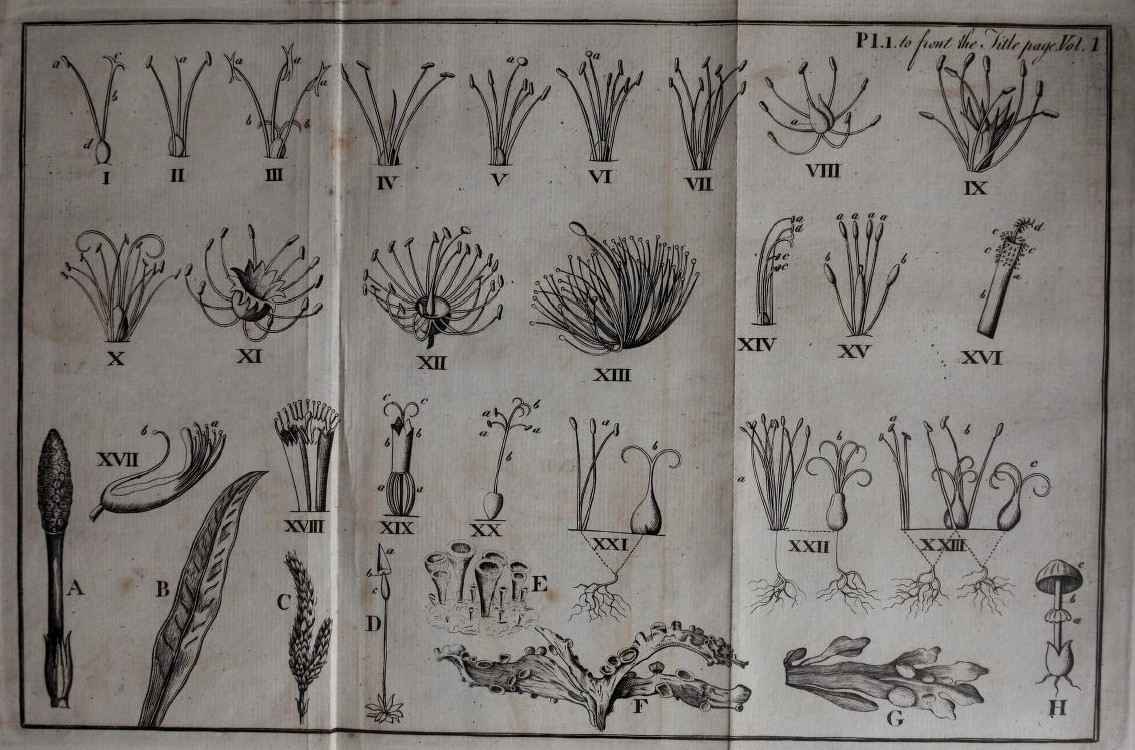
This system was celebrated in verse by Erasmus Darwin (Charles Darwin’s grandfather) in ‘The Loves of Plants’ (1791), part of his The Botanic Garden. It is filled with footnotes expanding on the botanical topics of the poem. However, considering that Linnaeus had compared the sexual parts of flowers as husbands and wives, an analogy in which Darwin rejoiced, there were some sectors of society who felt that Linnaean botany was inappropriate for young women. Charlotte acquired a copy in the year it was published and described it eight years later as “one of my favorite books”.
Moving to Storrington in 1793 (an “obscure village near Petworth”), the lines in her poems such as “And Spring’s soft blooms with pencil light I drew” continue to demonstrate her engagement with plants, though her health was failing, with pain and swelling in her joints. Adopting a different tack, Charlotte wrote two books aimed at children, Rural Walks and Rambles Farther, the purpose of which was to introduce countryside, nature and plants to young people, and it is in connection with these that her correspondence includes her first mention of James Edward Smith when she requested a copy of “Smith’s Tour” from her publishers to help her correct the plant names she had used.
James Edward Smith (1759-1828) was the owner of Linnaeus’ collection, founder and president of the Linnean Society, and engaged in the publication of many botanical works. By the mid-1790s he was an important locus of British botany, and had a wide correspondence network, reaching out across Europe. For this reason, Charlotte Smith’s surviving letters to him are invaluable, demonstrating that she reached out to, and maintained and developed contact with, one of the most significant figures in the science of plants at the time.
Four of her letters to Smith survive in the archives of the Linnean Society; two were previously published in a conflated form in the nineteenth century, which subsequently appeared in The Collected Letters of Charlotte Smith (2003). The rest of this correspondence has not received adequate critical study, and we can see that these letters are a vital source for enriching our understanding of Charlotte Smith, her life and her botany.
Her first letter dates from February 1797. In it she seeks employment as a botanical illustrator, an aspect of her life that is not revealed in any other sources: “I have heard that you Sir are engaged in the publication of one or more magnificent works of natural history—I beleive persons who colour such subjects are not very easily met with—It is a sort of occupation which I beleive I could undertake being I think able to copy with nicety, either the figure or colour of any plant I should see, either from nature or from drawings or engravings”.
The work in question was undoubtedly English Botany, which James Edward Smith had been engaged on with the botanical artist James Sowerby since 1790, and which appeared in regular issues. We don’t know how James Edward Smith responded, but this is unlikely to have been a realistic avenue for Charlotte; the illustrations were Sowerby’s domain, and he already had an established team of experienced illustrators and colourists working on the publication.
Nevertheless, the reply to her letter must have been welcome and encouraging, for within days of receiving it Charlotte wrote the sonnet ‘To the Goddess of Botany’; it is hard to believe that the receipt of a letter from a pre-eminent botanist could not be the trigger for the composition of such a poem. It starts by placing us in her current mindset, in which she is “Of Folly weary, shrinking from the view / Of Violence and Fraud, allowed to take / All peace from humble life”, and presents a wish that the author could “learn the bright varieties” of flowers to “find shelter”. I read the sonnet, imagining that it is James Edward Smith himself whom Charlotte is invoking to be her teacher.
He must have made practical suggestions to her too, since her second letter a year later notes that “I have not forgotten, (being still compelled to write that my family may live) your hint of introducing Botany in a Novel”. Indeed, she did try to do this with considerable precision in The Young Philosopher (1798), borrowing a copy of James Lightfoot’s Flora Scotica (1777) to ensure that she got the names of the plants correct. Some of the pages of the novel contain many footnotes adding the Latin names and additional details relating to the plants she mentions in the narrative. Even so, the odd mistake slipped through; her note on “the common bramble” reads “Rubus preticasus. There is something particularly elegant in the alternate triple leaves and the long weak branches of this plant.” This must be a printer’s misreading of her handwritten text of “Rubus fruticosus”; nevertheless, the important point is her drawing attention to the elegance of the form of this all-too-familiar plant, which we all pass by too easily.
The third letter further illustrates the increasing connection Charlotte was making with the botanical community in London and beyond. She notes that she had hoped to have met Smith, and also missed the opportunity to meet José Correia da Serra, a Portuguese diplomat and botanist, who had settled in London with the help and protection of Smith and Joseph Banks.
Another idea for a possible project that had clearly come from James Edward Smith was the creation of a small publication “to illustrate each of Linneas’s orders—to be etched with a page of Letter press to each & the characters done with precision for the use of botanical students”. Indeed, she noted to her publishers that “Dr James Edward Smith would correct it for me” and her sister would do the drawings. This venture certainly developed, since she asked Smith in her third letter whether “you not think me importunate if I send you three Drawings of my Sisters Mrs Dorsets, which she did as a beginning of her plan for the 2[4] Classes”, though there is no evidence that it was ever finished.
Increasingly ill, and finding that her income was decreasing, Charlotte continued to move. In Hastings in 1800 she wrote to a friend that “If I could not at times have been a little amused with the study of botany, which by sending out into the fields & hedges I could indulge here, I should hardly have sustain’d my fatigued spirits at all”. Later in the year she was in Tunbridge Wells, and had settled in Frant in 1801, during which time she had sold her precious books and had written Letters of a Solitary Wanderer.
She continued with her books aimed at children with Conversations Introducing Poetry (1804) and in this we find ‘Flora’, a longer poem with botanical content, subsequently reprinted in the collection Beachy Head. Amid all her troubles Charlotte Smith again takes us to botany as a solace, and the endnotes bloom with floristic embellishments, a section of which must have derived from her time on the coast at Hastings, as she describes Sea Poppy (Chelidonium glaucum, now Glaucium flavum), Sea Holly (Eryngium maritimum), Thrift (Statice armeria, now Armeria maritima), Saltwort (Salsola kali), and Tamarisk (Tamarix gallica), the latter being first mentioned there in James Edward Smith’s Flora Britannica (1800), though as Wolley-Dod (1937) notes it was first found at Hastings in 1796 by Edward and Thomas Furly Forster. It is still there today.
In this period Charlotte worked on material for a new collection of poems, and her last great long work ‘Beachy Head’ also includes much closely-observed natural history. Indeed, as Judith Pascoe from Florida State University has observed (1994), at times her text allows us to imagine her writing with William Withering’s book A Botanical Arrangement of All the Vegetables Naturally Growing in Great Britain at her side. These later poems show a closer attention to detail about specific plants, as well as more precision about plants in a locality. It would be fascinating to study more closely her mentions and use of plants (and animals) in her works: why does she choose to cite one species and not another? how much does her inclusion of plants in her poetry reveal about her developing knowledge and understanding of botany?
In her last surviving letter to James Edward Smith, dated 2 November 1803, this more assured engagement with the botanical world is also evident. Not only do we find her asking after their mutual friend Andrew Caldwell, an Irish MP, collector, botanist and Fellow of the Linnean Society, but also seeking an introduction to the great Sir Joseph Banks on behalf of a friend.
This letter also reveals Charlotte as a developing botanist, querying the author (J.E. Smith) when she finds a plant in a location that is not mentioned in her books:
“I observe that the Flora Britannica says the Oxalis Corniculata, is found about Exeter & in different places in Devonshire: without naming any other County … —I was therefore surprised to see it in the Garden of Mr Fearon of Cuckfield, who is a botanist, & told me he found it growing certainly wild, in a field two or three miles from the Town of Cuckfield in Sussex—from whence he obtaind it for his garden where it is now a weed, as it was from a root he gave me, at my late Residence”.
Fearon was the vicar of Cuckfield, and Oxalis corniculata was still an uncommon plant and relatively little-known, having been introduced to Britain in the seventeenth century, though was the only Oxalis other than acetosella that Smith included in his Flora Britannica.
Benjamin Smith died in a debtors’ prison in February 1806, and Charlotte died the following October. She did not live to see the publication of her last volume of poetry, Beachy Head, or A Natural History of Birds: Intended Chiefly for Young Persons. Neither did she see volume 24 of Smith and Sowerby’s English Botany, in which she and the record of Oxalis corniculata which she communicated is mentioned. Among all James Edward Smith’s huge network of correspondents that he cites in English Botany, few are women; Charlotte Smith was only the nineteenth woman he had specifically named since Sowerby first started the great work in 1790.
As it happens, William Borrer (described by Joseph Hooker as “the Nestor of British botanists”) subsequently noted that “The Oxalis “corniculata,” of Sussex, is in reality O. stricta. The specimens from Mrs. Charlotte Smith, mentioned in “English Botany,” were from an old orchard in Cuckfield, where I have myself seen O. stricta.” And so, we can remember Charlotte Smith when we read Frances Abraham’s description of Oxalis stricta in The Flora of Sussex (2018): “A generally non-persistent and decreasing weed of waste ground, gardens and allotments, most frequent on sands and gravels. The first record was probably in 1807 in Cuckfield.”
To conclude, we can consider the significance of Charlotte Smith in the context of botany and natural history. In a very narrow sense we could say that her sole botanical contribution is the misidentification of the first Sussex record for what is now a common alien weed, but that would be ahistorical, unfair and wildly inaccurate. I know of no other woman critically engaging with botany in Sussex before her; Eliza Lea in Eastbourne did not compile her lists of local plants until 1830. More importantly, in her books for children Charlotte Smith did much to encourage teaching and learning about the natural world, and she clearly was part of the expanding network of individuals, local and national, who shared and exchanged information about plants and other natural phenomena. And, in her other works she is an important botanical voice, crafting what Judith Pascoe has described as “a poetics of the botanically exact”:
By insistently focusing on the minute within even the grandest expanse, Smith suggests the escapist possibilities of the particular. Within the carefully delineated realm of the cottage garden, locus of female work and duty, Smith employs the extreme close up of the botanist’s gaze, creating an explosion of dazzling specificity, so that the limitations of a female vantage point become forces of liberation…. A new model of the Romantic poet is in order, one who, confronted with a field of daffodils, could count petals [stamens, surely?] before launching into verse.
References
Clemit, P., & Scott, B. (2020). Botanical Networking: Four Holograph Letters from Charlotte Smith to James Edward Smith. Romanticism, 26(1), 1–12. https://doi.org/10.3366/rom.2020.0443
Fletcher, L. (1998). Charlotte Smith: A Critical Biography. Palgrave.
Pascoe, J. (1994). Female Botanists and the Poetry of Charlotte Smith. In C. S. Wilson & J. Haefner (Eds.), Re-Visioning Romanticism (pp. 193–209). University of Pennsylvania Press.
Stanton, J.P. (Ed.) (2003). The Collected Letters of Charlotte Smith. Indiana University Press.
Wolley-Dod, A. H. (1937). Flora of Sussex. Kenneth Saville.