New Year Plant Hunt at Pagham
Meeting date: 30 December 2024
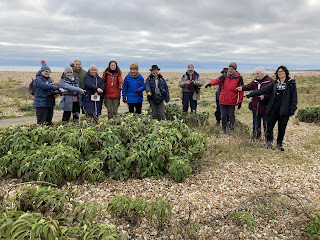
The best weather of the week favoured the seventeen SBRS participants who gathered at Pagham car park for winter botanising in the BSBI New Year Plant Hunt. Some had travelled from Wales, Dorset and even East Sussex to join us. The BSBI organises the New Year Plant Hunt which takes place over four days around New Year every year. The NYPH rules allow three hours of recording (rest breaks are excluded); only plants in flower can be counted. We were delighted to hear SBRS member Tim Rich explain how he had started the NYPH fourteen years ago. It is now a citizen science project involving more than 3000 participants, submitting nearly 25000 records, 647 different species in 2025. Bellis perennis (Daisy), Taraxacum agg (Dandelion) and Senecio vulgaris (Groundsel) are the top three most common species found nationally, and also recorded by us.
Pagham shoreline is well-botanised, and has been the site of previous small group NYPH outings. The rough carpark is always a happy hunting groun. Tim Rich demonstrated how to distinguish between Erigeron floribunda and sumatrensis (Bilbao & Guernsey Fleabane). Foeniculum vulgare (Fennel), Ceratochloa cathartica (Rescue Brome) and Sisymbrium orientale (Eastern Rocket) also grow at the carpark entrance.
We followed our usual circuit from the carpark down to the shoreline, turning west along the vegetated shingle beach. Much of the Laphangium luteoalbum (Jersey Cudweed) that usually grows on the Shore Road pavement had been weed-killed but we did find some flowering individuals. Another Pagham shingle speciality Anthemis punctata (Sicilian Chamomile) had some flowers. Other finds were Pastinaca sativa (Parsnip), Armeria maritima (Thrift) and Crithmum maritimum (Rock Samphire) on the shingle.
We had a coffee break in sunshine, perched on the fencing beyond the lagoon and returned along the shore roads, noting Polypogon viridis (Water Bent) and Parietaria Judaica (Pellitory-of-the-wall).
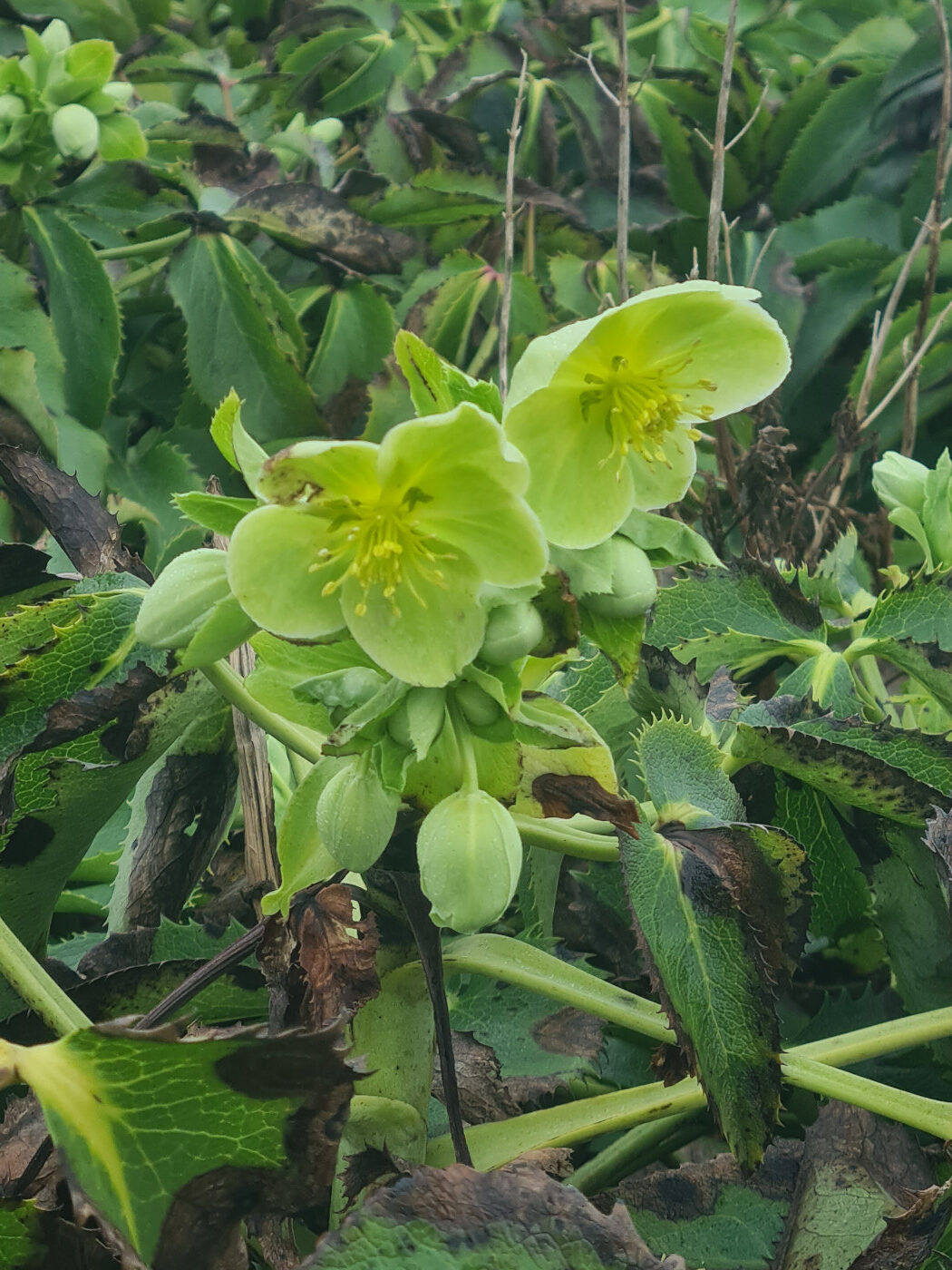
Returning past the carpark we went east, with the particular objective of Helleborus argutifolius (Corsican hellebore) which is long-established on the eastern shingle. A detour into the old dunes revealed Sedum kimnachii (Mexican stonecrop), also long-known.
We finished with refreshments at Pagham Beach Café. Our day’s species count was 67, ranking #15 in the NYPH longest lists. More detailed results can be found at https://nyph.bsbi.org/results.php. Find out more about the BSBI New Year Plant Hunt at https://bsbi.org/new-year-plant-hunt .