
Ashburnham Estate

Meeting date: 19 August 2023
(Leaders: Jacqueline Rose and Judy Clark)
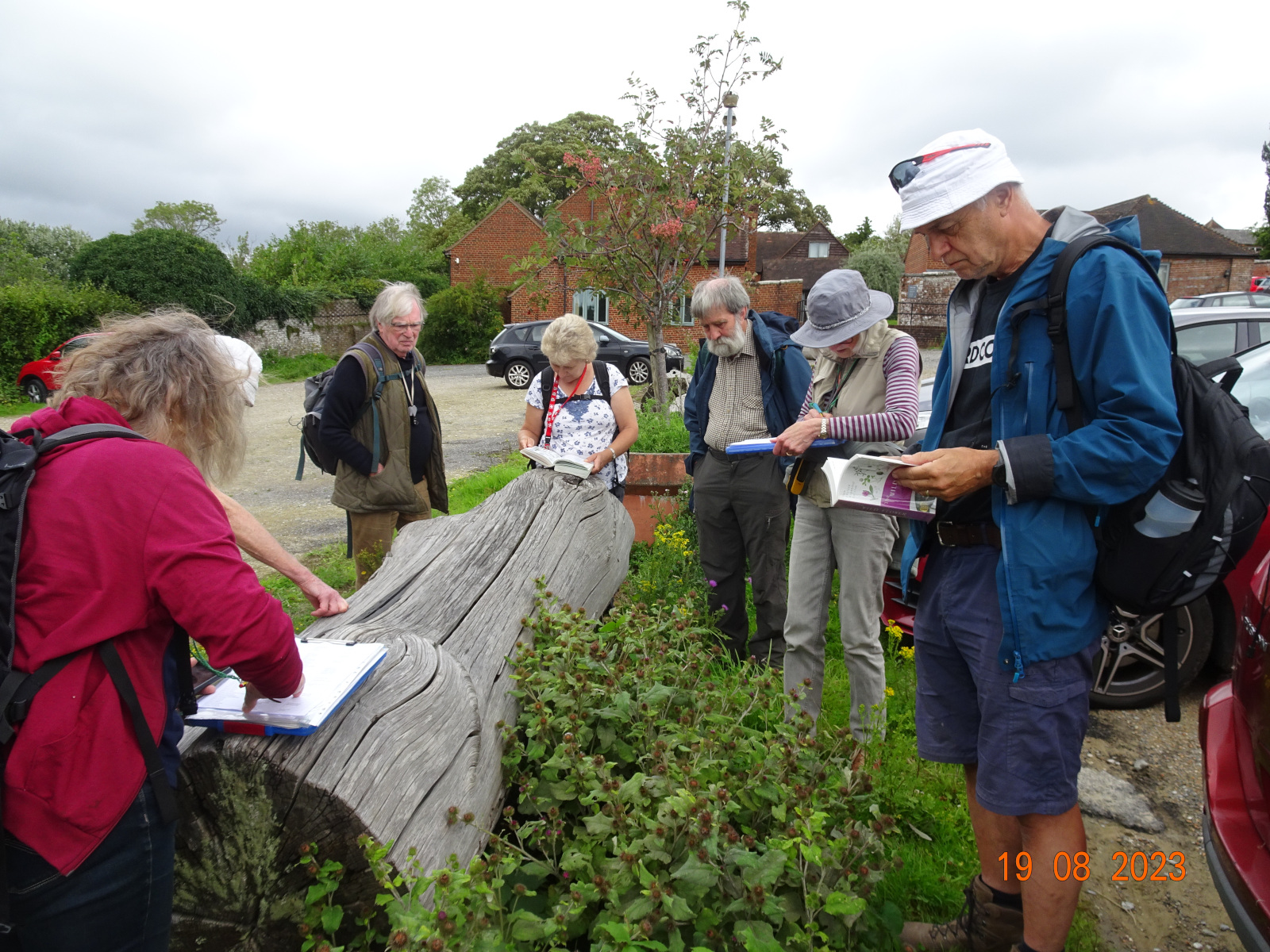
Despite the Farmers’ Market and the Craft Market there was plenty of room in the car park, where the eight of us met and spent far too long, as botanists do. There were a number of stems of a Conyza (now Erigeron) with red-tipped phyllaries, a character one associates with the uncommon E. bonariensis (Argentine Fleabane). On later investigation it turned out to be E. floribundus (Bilbao’s Fleabane), which it seems can also show that character. We discovered only one plant of Trachelium caeruleum (Throatwort), which had been more frequent on the walls during our last visit in 2015.
From the car park we headed towards the church. There are various meadows on the estate, which are being managed differently for comparison. One of them lies just behind the church, and we made a nice list of meadow species there, including Pimpinella saxifraga (Burnet-saxifrage). Tucked into a corner of the church were Athyrium filix-femina (Lady Fern) and Dryopteris filix-mas (Male Fern), the first of the ferns that had lured Trevor, our treasurer and fern enthusiast, to Ashburnham.

Through the gardens we saw more ferns on the walls: Asplenium scolopendrium (Hart’s-tongue), A. adiantum-nigrum (Black Spleenwort), A. trichomanes (Maidenhair Spleenwort), A. ruta-muraria (Wall-rue) and Polypodium vulgare agg. (Polypody). Then we headed to the terraces, to see what is reputed to be the largest colony of Adiantum capillus-veneris (Maidenhair Fern) in Sussex. Unfortunately it has suffered from the unhelpful weather patterns of recent years, and looked decidedly frizzled. We later found some much happier plants under the bridge by the waterside.
Refreshed by a lunch break, we walked down to Front Water, the lake seen from the terraces. That and the woodland beyond were very likely part of the vista in Capability Brown’s design. There was a good range of waterside plants. The Typha latifolia (Bulrush) and Menyanthes trifoliata (Bogbean) could have been planted at some time, also the Iris pseudacorus (Yellow Flag), but there was also Mentha aquatica (Water Mint), Oenanthe crocata (Hemlock Water-dropwort), Angelica sylvestris (Wild Angelica), and Equisetum palustris (Marsh Horsetail), and on the far side Myosotis laxa (Tufted Forget-me-not). The ride through the damp acid woodland characteristic of the High Weald is full of interest. Succisa pratensis (Devil’s-bit Scabious) grows near the entrance. A right turn off the main ride showed us Lythrum portula (Water-purslane), Callitriche stagnalis (Common Water-starwort) and Galium palustre (Marsh Bedstraw). Persicaria hydropiper (Water-pepper) was everywhere. In among Juncus acutiflorus (Sharp-flowered Rush) and J. bufonius (Toad Rush) were several plants of Scutellaria minor (Lesser Skullcap), a nice discovery, and a little further on Lysimachia minima (Chaffweed) – a single stem with its fruits like fairy apples, then, after much searching, a second plant nearby.