
Flatropers Wood
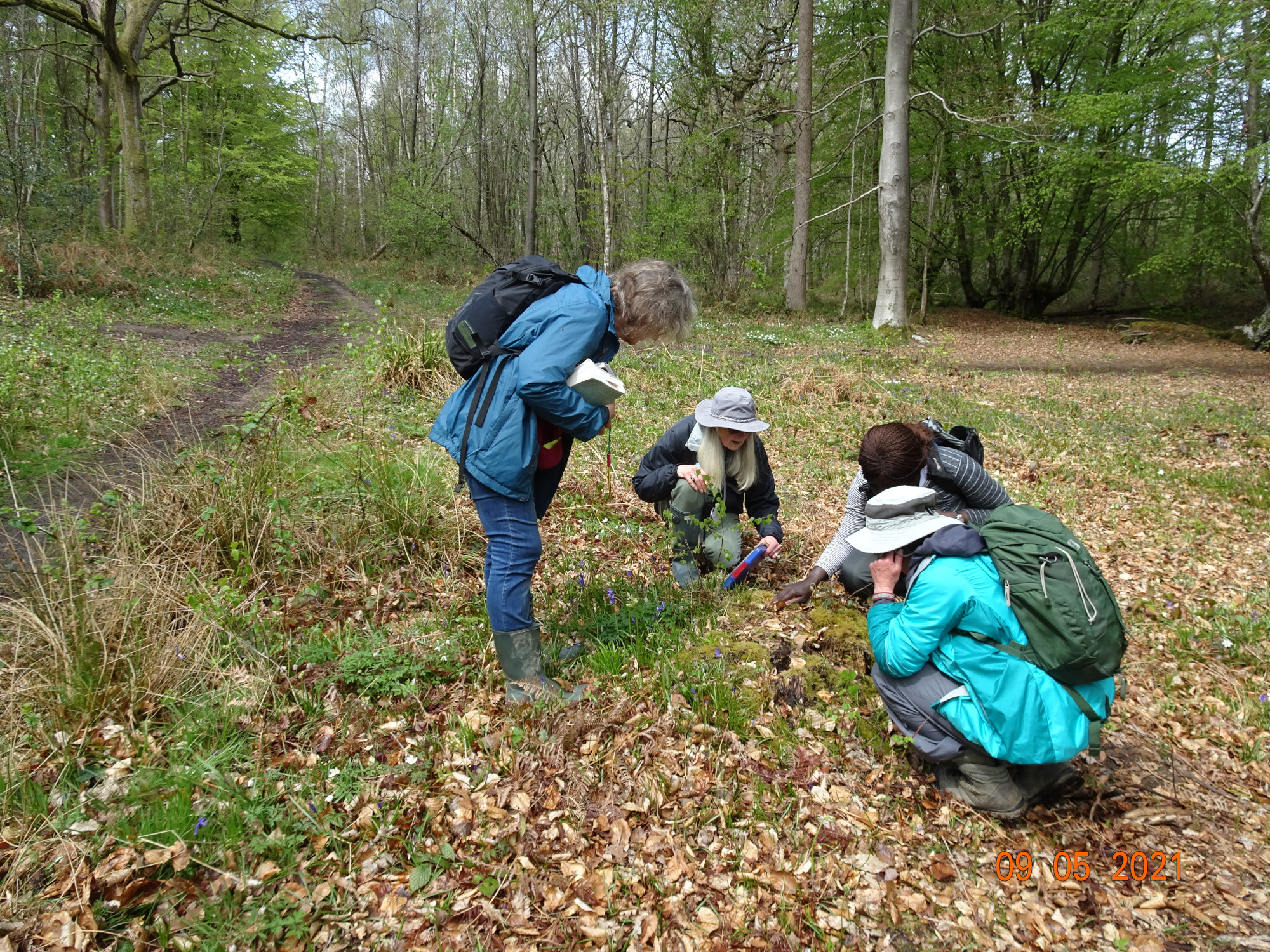
Meeting date: 9 May 2021
(Leaders: Jacqueline Rose and Judy Clark)
The Saturday meeting was postponed to Sunday due to a poor weather forecast. A cheerful group of five set off on a dry and mostly bright day. It is lovely damp acid woodland, with conifers and a good variety of broad-leaved trees, including Frangula alnus (Alder Buckthorn), the food plant of the Brimstone butterfly (Gonepteryx rhamni).
A stream runs through the wood, and we found Potamogeton polygonifolius (Bog Pondweed) in several places. The pond, which is on higher ground, was disappointingly dry as a result of the earlier drought, and Viola palustris (Marsh Violet), a speciality of the reserve, was reduced to about six leaves. Hydrocotyle vulgaris (Marsh Pennywort) had survived, however, and unsurprisingly so had the Oenanthe crocata (Hemlock Water-dropwort)! During lunch, we were fascinated to watch a species of Dor Beetle (Geotrupes) that seemed to be harassed by Red Wood ants. At a fairly open point in the stream, growing among Sphagnum moss, we found numerous leaves of Viola palustris – and, triumph, a bloom! The sunny glades had attracted Brimstone butterflies. In one glade we saw four sedge species: Carex laevigata (Smooth-stalked Sedge), C. binervis (Green-ribbed Sedge), C. pendula (Pendulous Sedge) and C. pilulifera (Pill Sedge), at their beautiful early male-flower stage. Also in flower were the woodrushes: Luzula multiflora (Heath Woodrush) and L. pilosa (Hairy Woodrush). Along the paths we spotted the leaves of Melampyrum pratense (Common Cow-wheat), which were spreading nicely, possibly helped by the wood ants carrying seeds to their nests.