
Beeding Hill

Meeting date: 9 July 2022
(Leader: Nick Sturt)
At the end of a decidedly warm day in the field, those of the eleven attendees still standing paused on the slope overlooking the Adur to record, at Frances’ bidding, the plants in a sliver of a second tetrad, TQ10Z. There were both Common Thyme (Thymus polytrichus) and T. pulegioides (Large Thyme) growing obligingly together on anthills so that their subtle differences could be appreciated, a smattering of Thesium humifusum (Bastard Toadflax) seen also earlier in the day, and some stems of Onobrychis viciifolia ssp. collina, the native form of Sainfoin.
We had toiled in the cauldron-like conditions of Anchor Bottom for several hours re-finding the calcicoles on the TQ20E tetrad list compiled for the Flora. The turf was parched but yielded the vast majority of these species, including Hippocrepis comosa (Horseshoe Vetch), Gymnadenia conopsea (Fragrant Orchid) and menacing tangles of Centaurea calcitrapa (Red Star-thistle). Frances showed us some choice snails, the choicest being Helicella itala (Heath Snail), here in some quantity. Some patient quadrat work achieved nowhere like the fifty species of legend quoted and queried by our President, but this is a very effective way of getting to know the species of a given habitat, especially grasses. As far as I recall, 24 was the record on the day. There was particular interest in the ten species known to occur requiring data for the Rare Plant Register. We did not encounter all of these but nevertheless some valuable notes were made. In the heat we gave up on Salvia pratensis (Meadow Clary) and eventually conceded that some entire basal leaves were Succisa pratensis (Devil’s-bit Scabious) rather than the sought-after Tephroseris integrifolia (Field Fleawort) not seen on this site for a number of years.
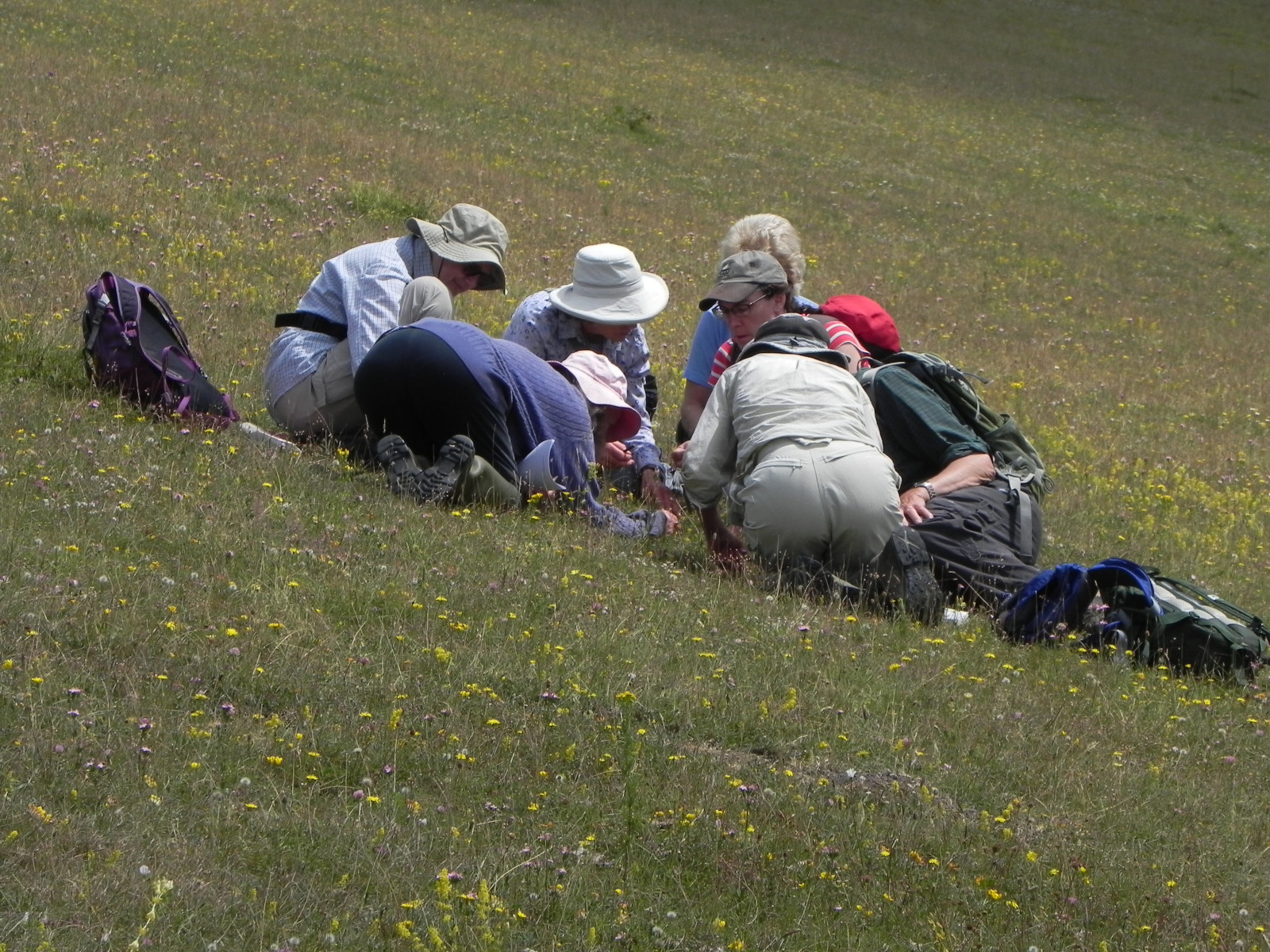
The south-facing slope of the combe had more than occupied the morning but in the afternoon we switched to its opposite, where a large number of new species were crossed off on the card. Many of these were taking advantage of the cattle-broken ground and included a few arable weeds, but it was also noticeable how a number of other species were more or less restricted to one side or the other. Good examples of those favouring the north-facing slope were Betonica officinalis (Betony) and Helianthemum nummularia (Common Rockrose), to which earlier in the season could be added Anacamptis morio (Green-winged Orchid). Thus it proved a day full of interest and as we headed back towards the cars Bob for one was not too weary to point out Passiflora caerulea (Blue Passion-flower) flowering in a hedge well outside the curtilages of the terraced houses of Dacre Gardens.