Ebernoe: Willand Wood
Meeting date: 19 May 2021
(Leader: Frances Abraham)
Six members walked through the Sussex Wildlife Trust’s Ebernoe Common reserve to Willand Wood, which SWT was in the process of acquiring. Willand is an ancient woodland site, part coppice and part now plantation, and it includes a small stream valley and marsh. It has a rich and varied flora. Our aim was to improve the leader’s out-dated list of records.
We spent the first hour in the valley, where the flora is enriched by a seam of Paludina limestone through the Weald Clay. The slopes support mixed coppice where, amongst the oak, ash, field maple and hawthorn, is a sprinkling of less widespread species, including Sorbus torminalis (Wild Service-tree), Crataegus laevigata (Midland Hawthorn) and Malus sylvestris (Crab). The ground flora has much Hyacinthoides non-scripta (Bluebell), Anemone nemorosa (Wood Anemone), Melica uniflora (Wood Melick) and Oxalis acetosella (Wood-sorrel). Ranunculus auricomus (Wood Buttercup) is an occasional wonky delight. The stream banks have an unusual abundance of Carex strigosa (Thin-spiked Wood-sedge). Helen found Lathyrus linifolius (Bitter-vetch) here; it has become scarcer in Sussex in recent years and was last recorded at Willand in 2002. Bob nobly splodged out across the stream into the marsh and produced samples of the flora for our inspection: Valeriana officinalis (Common Valerian), Scutellaria galericulata (Skullcap) and, oddly in this habitat, Sedum telephium (Orpine).
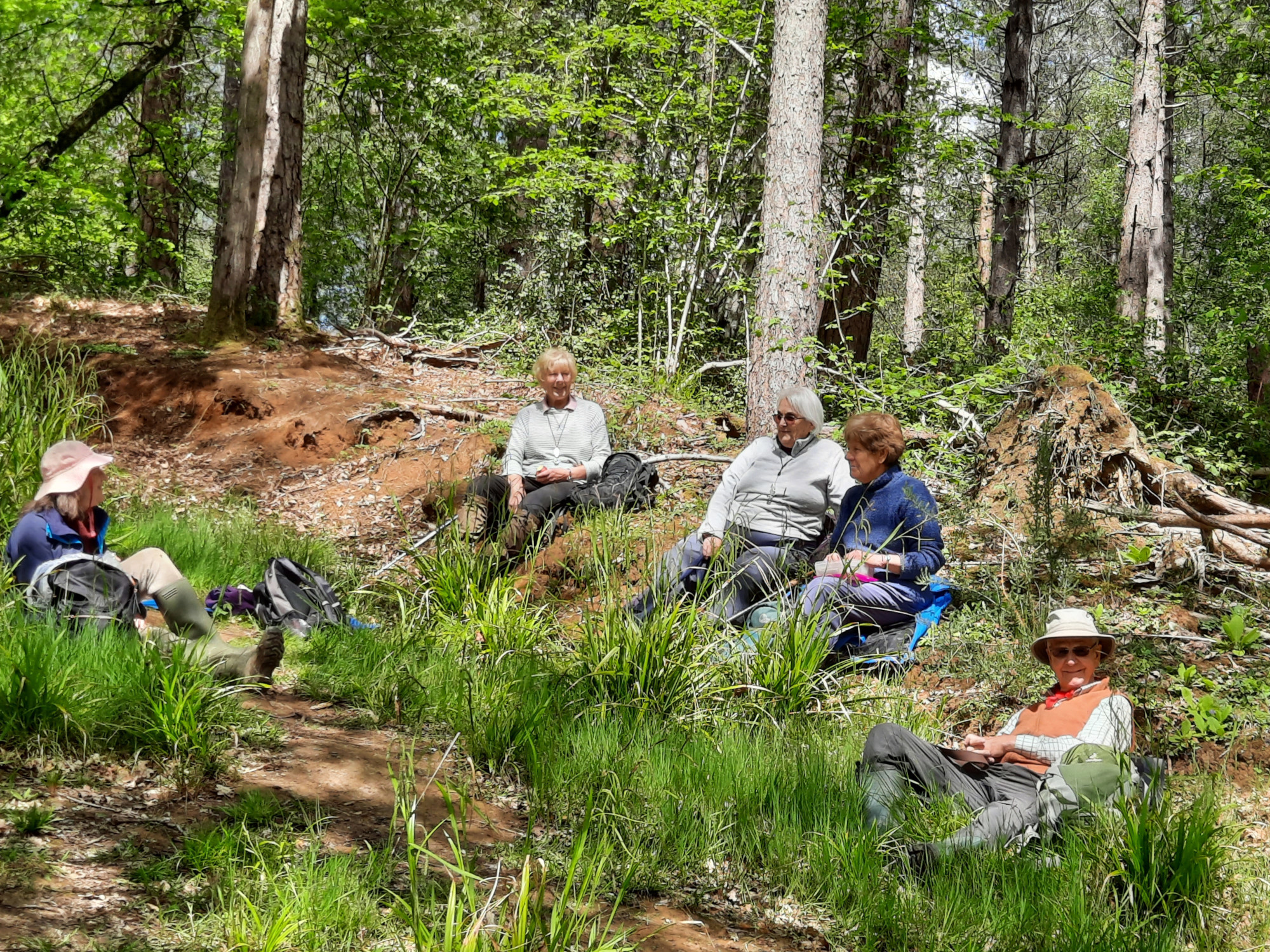
We scrambled to the other side of the valley and entered an area of conifer plantation. It formerly had wide grassy rides with species such as Succisa pratensis (Devil’s-bit Scabious), Potentilla erecta (Tormentil), Betonica officinalis (Betony) and Solidago virgaurea (Goldenrod). Tall vegetation has closed in over most of the rides but we did see a little of the first two species, and others of this habitat such as Agrostis canina (Velvet Bent). The sun smiled gently upon us as we perched on a sandy bank for lunch amidst much Veronica officinalis (Heath Speedwell), Luzula forsteri (Southern Wood-rush) and Hypericum pulchrum (Slender St John’s-wort). We then looked at the northern and western parts of the wood with their mixtures of native and introduced species. Amelanchier laevigata (Juneberry) was locally frequent, with species of damp acid soils, such as Frangula alnus (Alder Buckthorn) and Molinia caerulea (Purple Moor-grass). During the day we added seven new species to the list and updated numerous old records. We just failed on one thing: nobody claimed the prize offered for the re-discovery of Melampyrum pratense (Common Cow-wheat), which was last seen at Willand in 1996.