Amberley downland
Meeting date: 23 June 2021
(Leader: Richard Robinson)
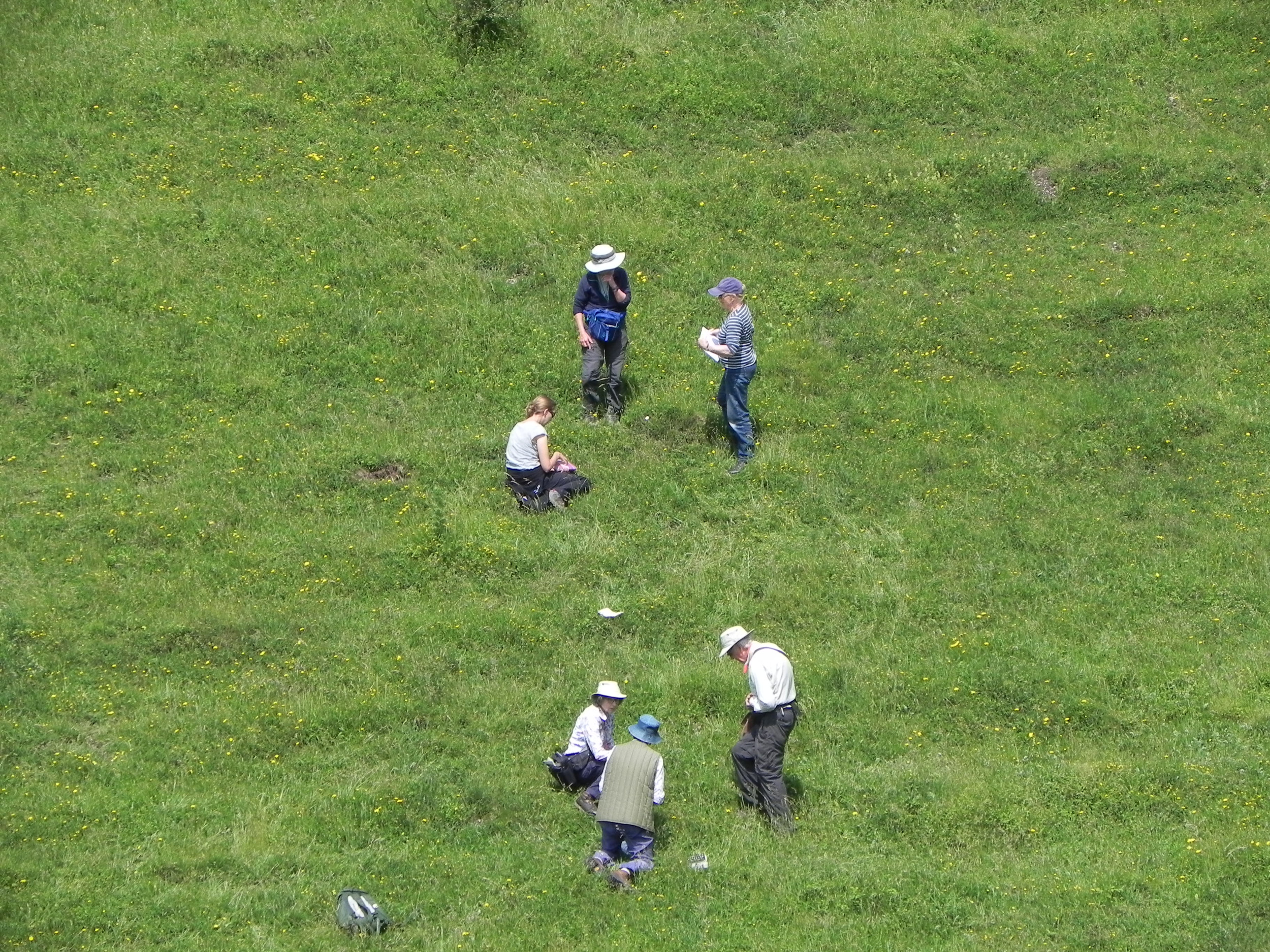
Thanks to the perspicacity of our Chairman twelve assembled on the day of constant sunshine which he chose in a week bookended by grey skies and driving rain. The lay-by in which we assembled adjacent to Downs Farm above Amberley contained a number of tempting species – statuesque Onopordum acanthum (Cotton Thistle) and Rapistrum rugosum (Bastard Cabbage) to name but two. However, on the reconnaissance the week previously it had taken us one and a half hours to get to our goal. Many a meeting has, as its prelude, the ‘get out of the carpark’ phenomenon but our goal was Medley Bottom. Unnamed on the maps, Medley Bottom is known to the locals and also to Michael Blencowe and Neil Hulme as a hotspot for butterflies in their magisterial book The Butterflies of Sussex. Under strict instructions therefore, looking neither to left nor right, within fifteen minutes the party found itself at the bottom of a huge dry valley of unspoilt downland sward, one slope facing approximately southeast and the other northwest. Both lay in the same tetrad but our earlier foray had suggested that the flora on the two sides differed and so we split into two groups to record the opposing slopes. At lunchtime the cards were compared. From the NW-facing slope 121 species were recorded and from the SE-facing slope 89. Expertise and eyesight in the two groups were judged to be similarly high.
The differences were considerable. Forty-five species were found on the NW-facing slope that were not recorded on the SE-facing slope. Conversely eighteen species were recorded on the SE-facing slope that were not found on the NW-facing slope. For the orchids for example, the contrasts were striking. On the NW-facing slope Dactylorhiza fuchsii (Common Spotted-orchid) was plentiful and Ophrys apifera (Bee Orchid) scattered – but there was no Anacamptis pyramidalis (Pyramidal Orchid). On the SE-facing slope A. pyramidalis was found, but not a single D. fuchsii or O. apifera. There were a number of Rosa canina (Dog Rose) and R. micrantha (Small-flowered Sweetbriar) bushes on the NW-facing slope, but none on the SE-facing slope. Similarly with Primula veris (Cowslip) and Helianthemum nummularium (Common Rock-rose). There were some stands of taller trees on the NW-facing slope including Fraxinus excelsior (Ash) and Viburnum lantana (Wayfaring Tree). This feature may have accounted for a number of species including Solanum dulcamara (Bittersweet), Galium aparine (Cleavers) and Urtica dioica (Common Nettle) which grew in their shade. Apart from sunlight hours and temperature the only other difference of possible significance is that the NW-facing slope fell evenly to the floor of the valley whereas the SE-facing slope was corrugated by horizontal ridges some 3-4” high and a foot or so apart.
Ruminating on this, after lunch we made our way southwards to the next fold in the Downs, known as Stoke Bottom. This was orientated similarly and we recorded 118 species from the SE-facing slope. This was similarly species-rich to the NW-facing slope in the morning but there were differences: Danthonia decumbens (Heath Grass) was present throughout; two fine stands of Atropa belladonna (Deadly Nightshade) were found in the lee of some trees; Filipendula vulgaris (Dropwort) appeared for the first time that day; and Helianthemun nummularium was more plentiful.
Arriving back at the layby one Sussex speciality was saved till last. Lonicera xylosteum (Fly Honeysuckle) still clings on in a hedge nearby. It has given up trying to grow towards the road where it gets regularly bashed and is now growing instead towards the wood behind. The twin berries were evident, yet to turn from green to red. Opinion is divided as to whether or not it is native. Notwithstanding, the woods above Amberley have long been known as a stronghold for the species.