Viola odorata (Sweet Violet)
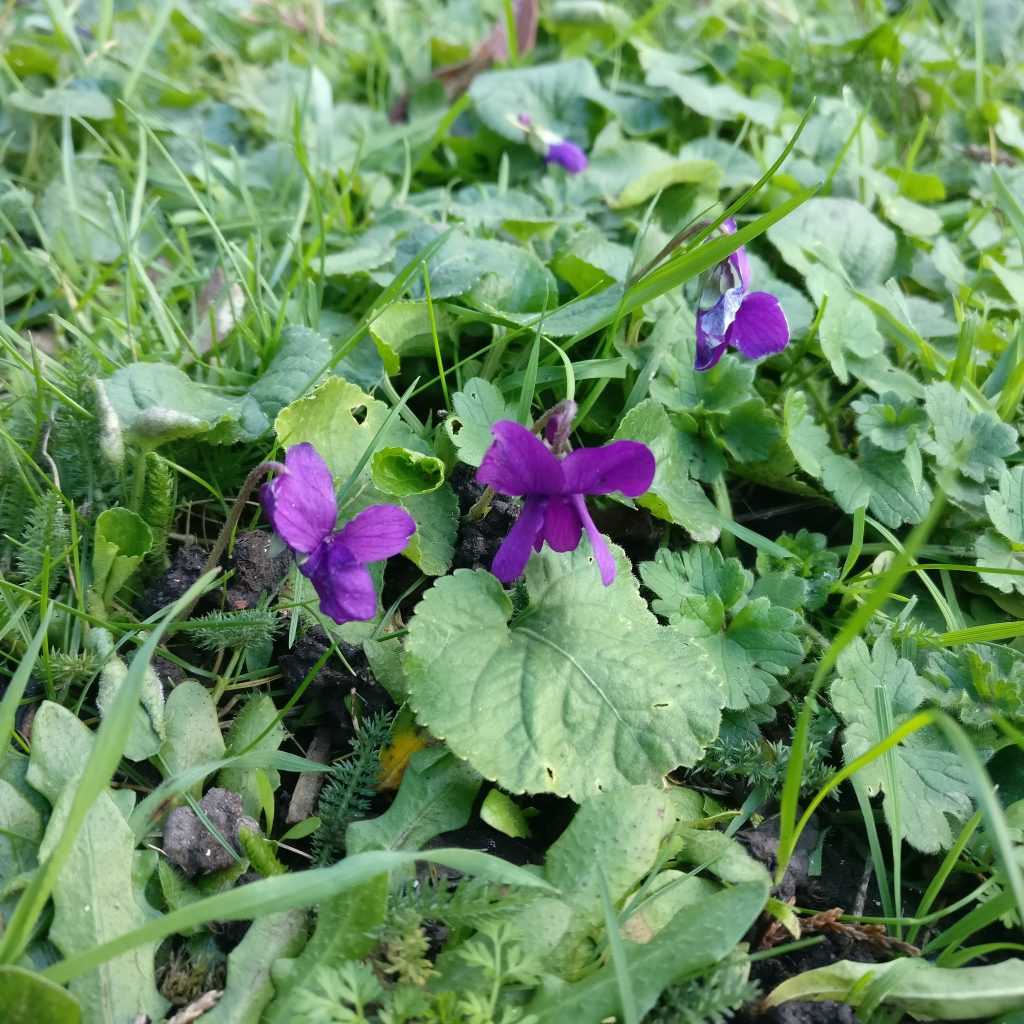
Viola odorata. Photo: Nevil Hutchinson 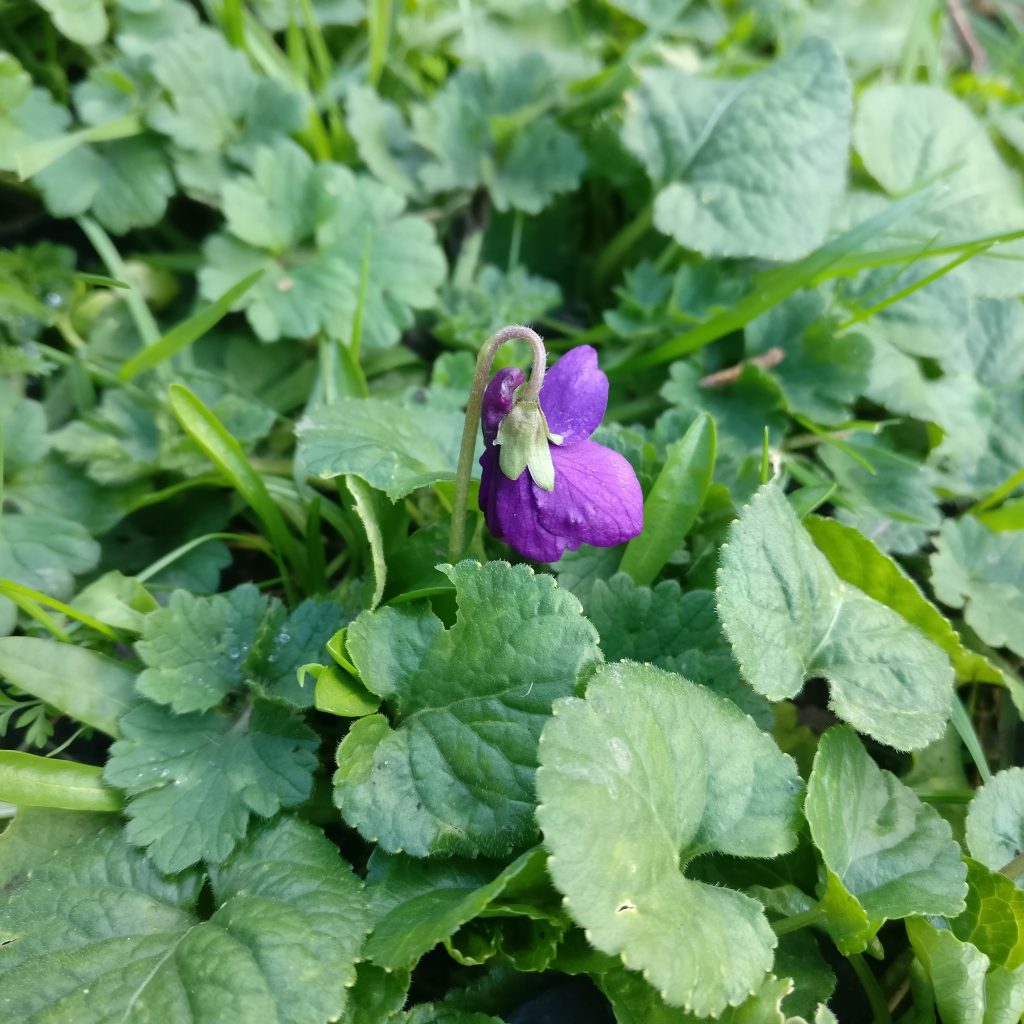
Viola odorata. Photo: Nevil Hutchinson
I thought we’d kick off with a common species that is flowering in many places at the moment. The photos are of plants growing in a Lewes verge. Its key features are set out in this very nice summary of the common species produced by Moira O’Donnell (@nervousbotanist on Twitter) for #wildflowerhour (@wildflowerhour on Twitter and Instagram).

The only violet you’re likely to confuse it with is V. hirta (Hairy Violet) as they both have blunt, rather than pointed, sepals and are both hairy (to varying degrees).
There are a number of ways to tell them apart (see above) but one of the easiest is from a distance: V. odorata is stoloniferous and consequently forms spreading patches, whereas V. hirta tends to form compact clumps. The leaves of V. odorata are almost circular (orbicular) whereas V. hirta has longer leaves (the ratio of length:width usually >1.6). Other differences require a close look at the flowers, leaf stalks (petioles), flower stalks (pedicels) and sepal appendages.
Here is the entry for V. odorata in our Flora. You can see that it’s quite widespread, avoiding the more acid areas of Ashdown Forest.
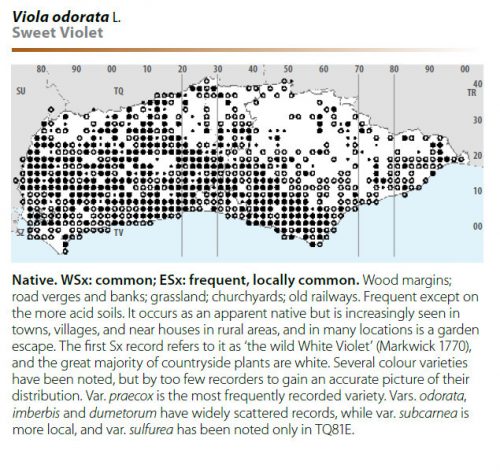
By comparison V. hirta is almost confined to the chalk grassland of the South Downs, although you can get caught out, as I was, when it appears on the limestone of old railway lines.
People assume that another reliable way to tell them apart is by smelling them. While it is true that V. hirta has no smell, the smell of V. odorata is very variable. It is apparently temperature-dependent, being barely detectable in the cold. Some say that bringing the flowers indoors will result in the scent filling a warm room, but the only time it’s been obvious to me was on a hot, still, spring day when the sun heated a south-facing bank covered in them.
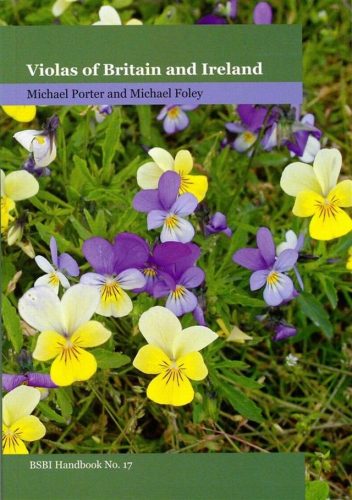
You will notice the entry in the Flora refers to a number of varieties. These are interesting to look out for but beyond the scope of this article. If you’re really interested in the violets (and there are 14 species, plus the Garden Pansy which sometimes escapes into the wild, plus various hybrids and variations) then you should get yourself BSBI Handbook No. 17: Violas of Britain and Ireland.