
Chichester Asparagus
Source: Sturt, Nick. “Chichester Asparagus.” Sussex Botanical Recording Society Newsletter, no. 92 (January 2021). https://www.sussexflora.org.uk/wp-content/uploads/2022/02/Newsletter_jan_21.pdf.
The splendour of the city of Bath – its terraces and crescents and mansions, all in the mellow local stone – can be appreciated to the full from the perspective of the designated Skyline Walk on the hills which form something of a natural amphitheatre around it. On one such walk some years ago on a cloudless April morning it was natural for the botanist to look at his feet whenever he could wrench his gaze from the man-made beauty filling the larger vista, and on more than one occasion when he did so he recognised the dull greyish-green basal leaves of the plant whose simplified outline graces the way-markers of the trail. The inhabitants of Bath recognise their speciality plant, and in times past they used to harvest it to sell in their markets and further afield as a substitute for Asparagus. A glance at the distribution map in New Atlas of the British Flora (2002) confirms Ornithogalum pyrenaicum – Bath Asparagus – to have its headquarters in the area immediately around the city, although there is a thin scattering of records over the southern half of Britain. Recent authorities generally treat it as a native but there has from time to time been just the faintest shadow of a doubt about this.
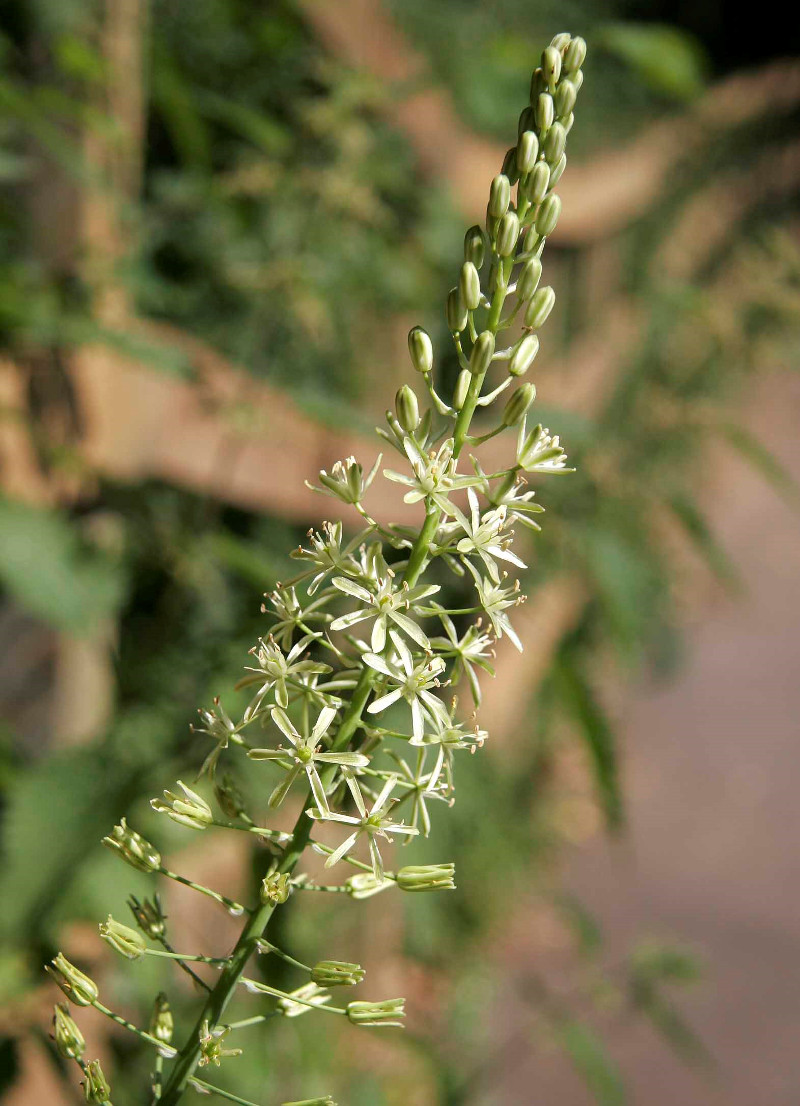
The distribution of this species has been the subject of much discussion and a modicum of research, since its first notice by Thomas Johnson when reporting on a plant-hunting tour in the Mercurius Botanicus of 1634: ‘Ornithogalum angustifolium majus floribus ex albo virescentibus… Onion Asphodell, Green starre flowre. It growes in the way between Bathe and Bradford [-on-Avon] not farre from little Ashley’. Because early Bath is associated with the Romans and this Ornithogalum seems to be a native of Rome’s homeland and its provinces around the Mediterranean there has long been the theory that the plant came with them. One theory proposes that the bulbs were accidentally imported in the root-balls of the vines which the conquerors planted (no doubt in unflinchingly straight Roman rows!) upon the hillsides around the settlement they called Aquae Sulis. This putative origin is mentioned, along with much else of interest, in an essay on the species by David Green in the Wiltshire Flora of 1993. When I made inquiry some twenty or so years ago there was genetic research planned in the hope of shedding light on the populations of Bath Asparagus in the neighbourhood of the city, but I am unaware of any notable results forthcoming. The question of native or introduction is not one I am competent to tackle: my researches, which have been conducted largely from the comfort of my armchair, centre instead on the presence of Bath Asparagus in a site in Sussex. I have been pressed by the editor on several occasions to set out my thoughts and this time I have run out of excuses.
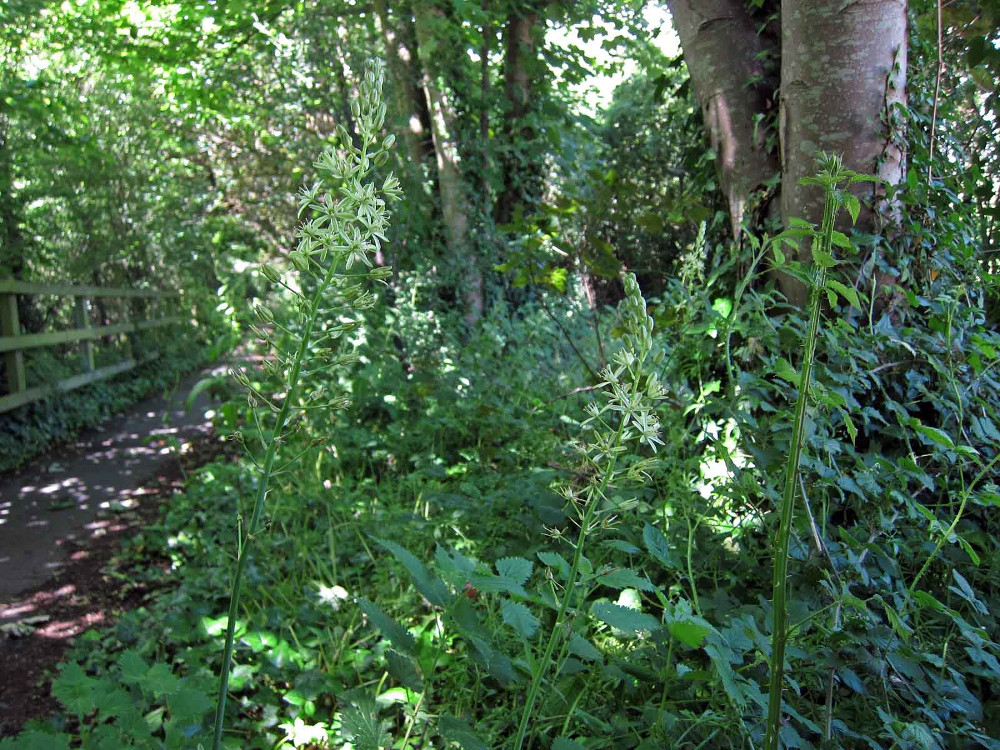
Among the scatter of dots across England for O. pyrenaicum in the New Atlas of the British Flora is the hectad SU80, narrowed down in the Sussex Plant Atlas and the recent Flora to tetrad SU80M and representing finds in Fishbourne outside Chichester. The first record goes back to Dillenius in his famous third edition of Ray’s Synopsis methodica stirpium Brtiannicarum, published in 1724. He was informed of the presence here of our plant by his correspondent Mr (or Dr) Manningham of Slinfold and the location is described as ‘on the left Hand of a Farm half a mile from Cicester [sic] Southgate in a Meadow plentifully’. In the 19th century Rev Frederick Arnold, for some years a resident of Fishbourne, knew the species well and evidently in those days it was to be found in a number of places around the village. Today its stronghold is a short section of Apuldram Lane where it survives despite sporadic attempts by the authorities and locals to tidy up the bank in question. The site could well accord with Mr Manningham’s. When the A27 was re-aligned in the 1980s our late Chairman Rod Stern organised volunteers to transplant some bulbs out of the way of danger and a few plants probably arising from this work can usually be seen around the car-park for the parish church and on the verge of the new A259. I have not had any success myself in finding it elsewhere in the village, although it may well be present in private gardens. I should very much like to see it established in the recreated fragment of the garden of Fishbourne Roman palace, because I feel that this could be the origin of the Fishbourne population.
It is ironic that Arnold, an enthusiastic ‘antiquarian’ as well as a botanist, had no inkling of the astonishing Roman remains beneath his feet. They were excavated in the early 1960s following pieces of mosaic and masonry being unearthed when a water main was being laid across a farmer’s field and the subsequent dig was conducted by a young Barry Cunliffe. What was found turned out to be the relics of by far the largest known Roman building north of the Alps, a villa on such a massive scale as to be termed a ‘palace’, with the evidence for ownership pointing straight to the client king of the local Regnenses tribe, one Cogidubnus. Since that identification was made historians have corrected the spelling of his name to Togidubnus, but I shall stick with the more familiar form.
In a former life I used to teach Classics and eventually adopted the disappointingly modern Cambridge Latin Course: to its credit, this does impart a great deal of worthwhile information about Roman and Romano-British life even if it skimps on the sort of rigorous grammar mastered by pupils of the calibre of our own Priscilla Nobbs. In Unit III there is a story made up which takes King Cogidubnus to Bath to seek a cure for an unspecified ailment from the goddess Sulis at her spring. The spring pre-dates the Romans but with their innate superiority they were happy to assimilate the cult and identify the goddess with the Roman Minerva. For many years I taught the probably fictitious tale of the poorly Cogidubnus being plotted against by a dastardly Roman magistrate before I became aware that historians now believe that the lucrative shrine at Aquae Sulis was for a time actually controlled by Cogidubnus. It would not be impossible that he could have made the journey to Bath to inspect it (or, come to that, in order to be cured of some illness), but in any case the link predicates lines of communication between Fishbourne and Bath – lines along which Bath Asparagus might conceivably travel.
What follows are unsubstantiated theories, all of them more or less impossible to test, about how Ornithogalum pyrenaicum could possibly have come to Fishbourne. Firstly and perhaps most obviously, we can leave out any Bath connection and imagine the accidental arrival of bulbs in those root-balls of vines, for vines were surely imported for cultivation in the king’s garden as a key symbol of his Romanisation. But let us pursue a putative Bath origin. Perhaps the plant was associated with the goddess and her spring. As a native it could have had cult significance long before the Romans arrived; as an introduction the association will have developed later. Whatever the case, if Bath Asparagus were seen as an accoutrement or part of the paraphernalia or ritual of the goddess Sulis then it would be natural, arguably, for Cogidubnus to acquire some for his garden; or certainly to be sent it by the administrator-priests of the shrine in recognition of his power. These are, I admit, only theories, but theories which try to account for the remarkable coincidence of a comparatively rare plant in England occurring next door to two major Roman sites. Just as Bath Asparagus has putatively survived since at least Roman times on the slopes once bearing vines around Bath, so it will have been capable of remaining in Fishbourne centuries after the palace was abandoned (around AD 270 following a fire) and its gardens overrun with invading barbarian vegetation.
Earlier mention was made of the sale of Bath Asparagusas a vegetable gathered and sold in historical times. Could then the Romans have deliberately introduced the plant for the table? I have been unable to find any written evidence for the consumption of Ornithogalum pyrenaicum by the Romans, not in Pliny’s encyclopaedic Natural History, not in Columella’s treatise on agriculture, not in the recipes described by Apicius. The word ‘asparagus’ has a basic meaning of edible shoot in Greek, which was absorbed into Latin, but we know that what we call Asparagus was the same vegetable regarded by the Romans as a delicacy. Apicius recommends that for best results it should be placed in the saucepan with the heads out of the water; and I also remember the historianSuetonius mentioning that a favourite saying of the emperor Augustus was ‘quicker than boiled Asparagus’, although I shall refrain from speculating about what exactly he had in mind. But returning to the point, I would suggest that the case for Ornithogalum pyrenaicum as a home-grown vegetable at Fishbourne palace is not convincing.
Reference was made earlier to the distribution map in the New Atlas of the British Flora: I should point out that the dot indicating its presence in the Fishbourne hectad is printed in red to indicate introduced status, and the accompanying text notes that the species is cultivated in gardens and can ‘escape’ and become naturalised. My own palace garden theory, of course, presupposes this and we need venture no further to find corroboration than Henfield and Borrer’s Bank (TQ21C) where our plant still occurs as a relic of the great man’s garden. I should not omit to mention here that I have read the explanation of the presence of Bath Asparagus in Fishbourne as a much later introduction by an unidentified rector of the parish who was previously based in Bath. I suspect, however, that the fact that our plant used to be found in various spots around the village tends to render the horticultural vicar theory a degree less likely. The romantic in me infinitely prefers Cogidubnus and his Aquae Sulis connection. I imagine the material being conveyed by the Imperial post service and, after a cursory inspection by the King, being handed over to the Head Gardener to nurture with due care. And it is pleasant while pausing in Apuldram Lane and admiring the handsome flowering spikes to conjure up the unprovable link to Roman Britain of nearly 2000 years ago. If this thought helps to ensure the survival of Bath Asparagus in this site then so much the better.
*
As a postscript I must mention that in the course of writing this I have been reminded of SBRS stalwarts connected with our Ornithogalum. I recalled that Anne de Potier of the Chichester Harbour Conservancy had been in the working party which transplanted the bulbs and when I asked her she kindly recounted what she remembered of the operation. I should not neglect to mention Judy Wilson who for probably more than thirty years has been making a pilgrimage to the main site every June in order to monitor the population.