
Pulborough Brooks
Meeting date: 21 September 2024
(Leader: Brad Scott)
Joint meeting of the British Bryological Socety SE Group and the SBRS.
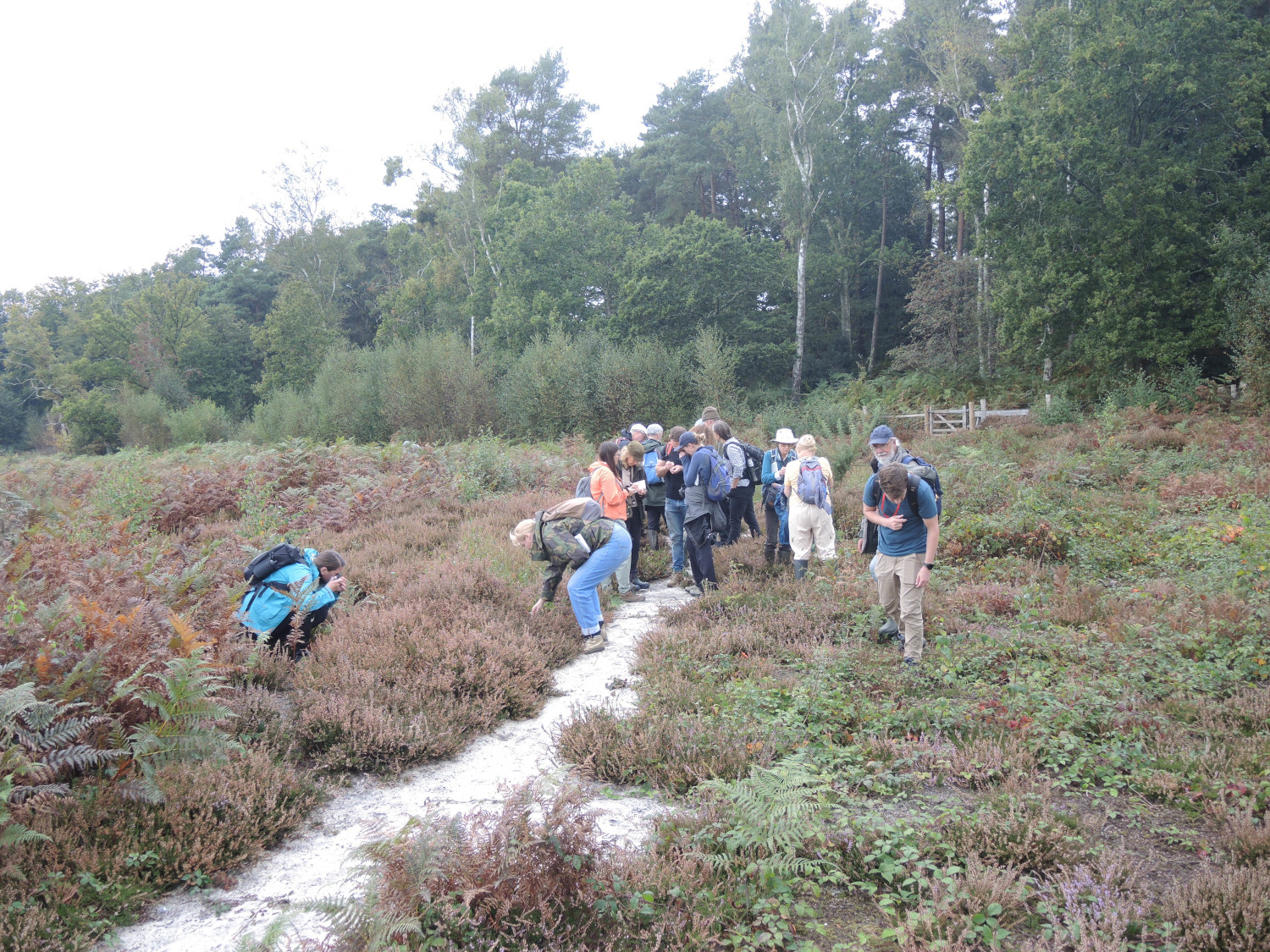
Sue Rubinstein and I thought that Pulborough Brooks RSPB reserve would be an ideal target for a bryological field meeting: not only did TQ01N have just 37 species recorded, but it is designed to be visited, with a substantial car park. However, even we were a little surprised (and delighted) to have 22 people turn up, a high proportion of whom were relatively new to bryology.
We targeted three areas: the heath and bogs at Wiggonholt Common; some of the small bits of woodland in the higher part of the reserve; and, of course, the car park. Most of the previous recording in the area took place in the 1990s, and included some interesting finds, such as the record of Grimmia trichophylla found by Francis Rose, Rod Stern and Howard Matcham, Pleurozium schreberi on the heath, and also Leptodon smithii (now Neckera smithii). However, there were also dozens of common species that hadn’t been recorded there at all, so it was clearly worth a visit.
First off were the distinctive ‘bottle-brush’ stems of Polytrichum formosum and P. juniperinum, with their toothed and untoothed leaf tips. Other common species on the soil were Pseudoscleropodium purum, Hypnum jutlandicum, numerous tufts of Dicranum scoparium, and many large patches of the invasive Campylopus introflexus with its reflexed white leaf points. One group found some Tetraphis pellucida on a stump by a small pond.
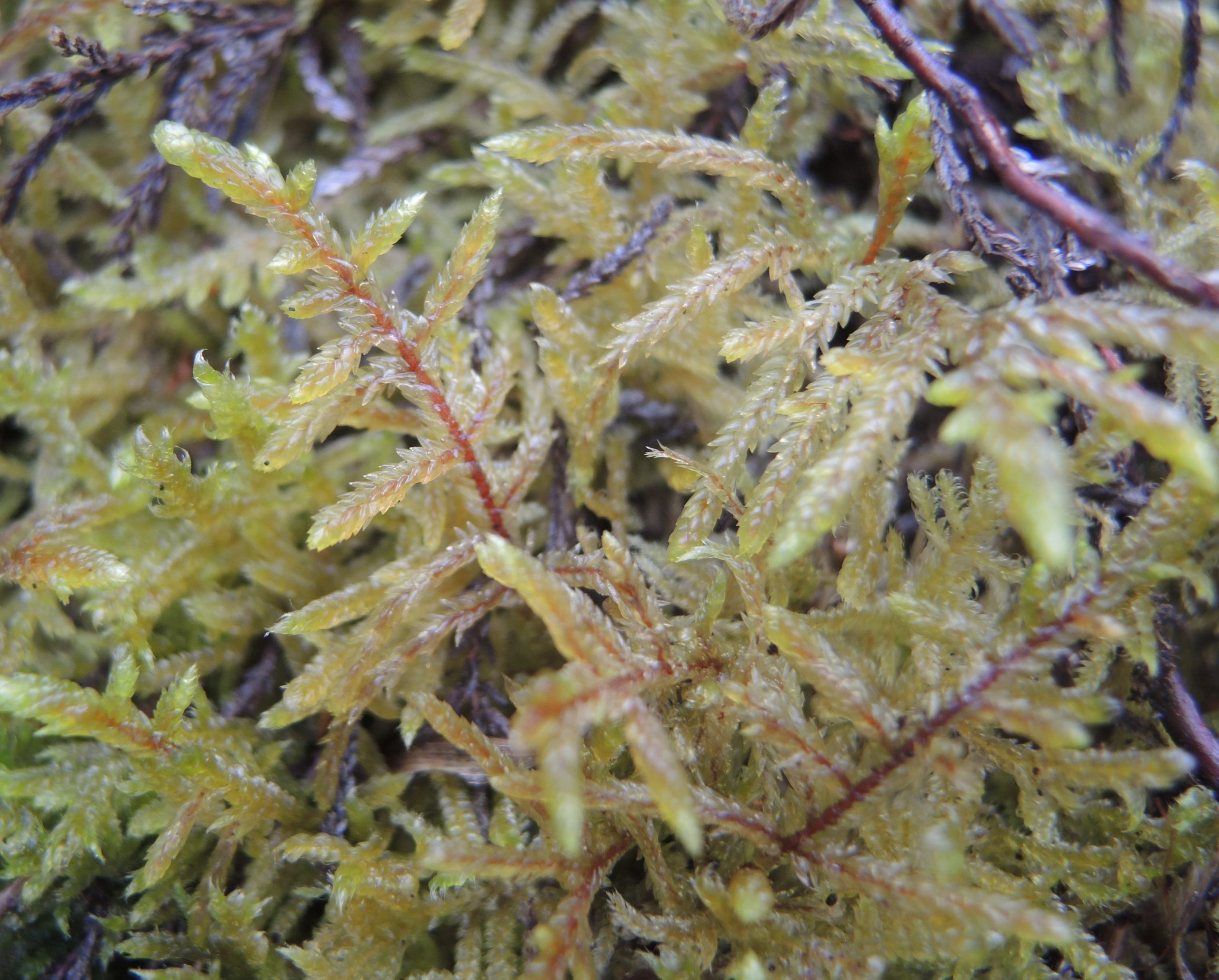
Heading towards the southern edge of the fenced part of the heath, we found several nice patches of the beautiful red-stemmed moss Pleurozium schreberi, along with many pale green patches of the small liverwort Cephalozia bicuspidata. Nearby was the biggest of the boggy ponds, which occupied us for some time as we explored the various Sphagnum species that were growing there. The wettest areas were home to S. fallax, S. fimbriatum, the pale S. palustre with its dark capitulum, and the ‘drowned kitten’ S. cuspidatum. Sphagnum auriculatum (= S. denticulatum) was on the slightly drier edges. Some of the latter was intermixed with the pale green mats of Leucobryum glaucum, which Sue confirmed by checking that its leaves had large lateral pores in longitudinal section.
After lunch we slowly worked our way back towards the car park, examining the drier heathland banks for the very common Kindbergia praelonga, Mnium hornum, and Dicranella heteromalla. It provided also our first interaction with epiphytic species, primarily the common liverworts Metzgeria furcata and Frullania dilatata, along with the moss Hypnum cupressiforme var. resupinatum. Our final target area was up near the Hanger hide, where the paths are lined with old Field Maple. We added many new epiphytes, including Radula complanata, the very tiny liverwort Myriocoleopsis minutissima, plus the mosses Cryphaea heteromalla, Neckera complanata, Zygodon viridissimus, and Pulvigera lyellii (= Orthotrichum lyellii) with its masses of brown gemmae.
In all we recorded 57 taxa, bringing the tetrad total to 69, which is beginning to be a more respectable number for this part of the county. Many thanks to Ruth Gillies and colleagues at Pulborough Brooks RSPB reserve.
[This is an abbreviated version of Brad’s full report on the Sussex Bryophytes blog]