
Markstakes Common

Meeting date: 22 April 2023
(Leader: Jacqui Hutson)
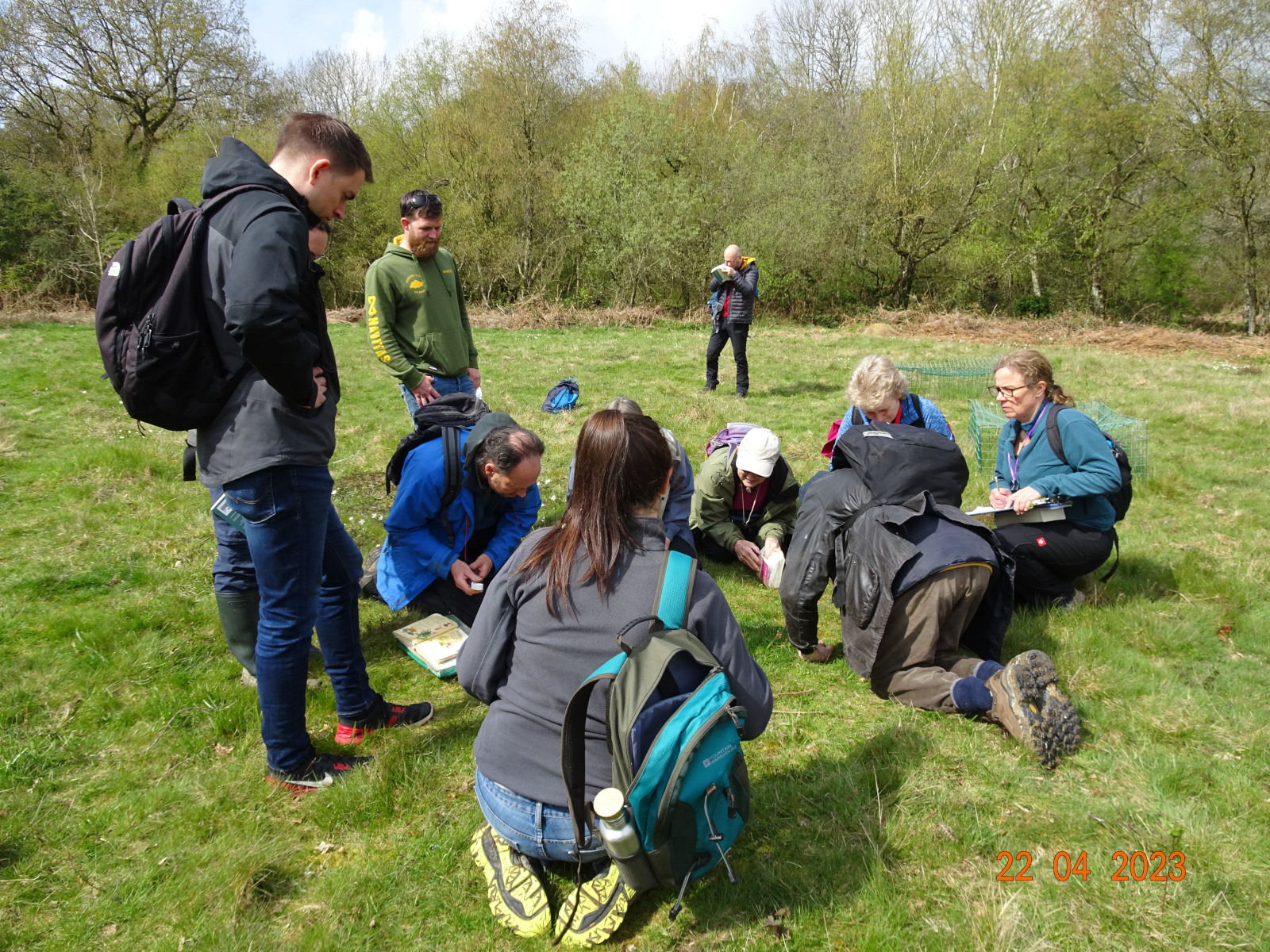
After several days of damp and dreary weather, Saturday 22 April promised to be better. After a grey start the sun shone on the twelve members who met for a visit to Markstakes Common. Of these, three were new members at their first SBRS field meeting. Most of the Common falls within two tetrads and we started in the northerly one TQ31Z. The Common here is predominantly woodland with a small clearing in what was dense bracken twelve years ago. It was cleared by members of the Friends of Markstakes Common and is maintained by ‘weeding’ birch, bracken and bramble. After recording the woodland flora with abundant Anemone nemorosa (Wood Anemone) and Hyacinthoides non-scripta (Bluebell), we focused on the cleared area. Here we found, among the Agrostis capillaris (Common Bent) sward, several plants of Calluna vulgaris (Heather), Carex caryophyllea (Spring Sedge), Galium saxatile (Heath Bedstraw), Luzula campestris (Field Woodrush), Veronica officinalis (Heath Speedwell) and Potentilla erecta (Tormentil).Most exciting of all, however, was the discovery of a single small individual of Genista tinctoria (Dyer’s Greenweed) by some members crawling around with noses close to the ground.
On through the woodland we recorded Frangula alnus (Alder Buckthorn), including what must be a very old specimen, as well as young saplings we encountered near the entrance to the Common. A row of Crataegus laevigata (Midland Hawthorn) just coming into flower led us to a large shallow pond (an old clay pit) where we added Glyceria fluitans (Floating Sweet-grass) and Solanum dulcamara (Bittersweet) and, on the bank, a solitary Sorbus torminalis (Wild Service-tree). Reaching TQ31Z, still in woodland of mixed Carpinus betulus (Hornbeam) and Quercus robur (Pedunculate Oak), the first record here was a nice clump of Ruscus aculeatus (Butcher’s-broom). It was time for lunch, which we had in a clearing which was dense birch fourteen years ago. Calluna vulgaris had colonised here and was well established. We also recorded Deschampsia cespitosa (Tufted Hair-grass) and Avenella flexuosa (Wavy Hair-grass) but the highlights were a tiny Longhorn moth that settled on various members’ clothing and was tentatively identified (later confirmed by a friend of mine who knows his moths) as Adela reaumurella, a Slowworm and a Common Lizard. After lunch we set off to explore an old claypit, which the Friends call The Mire. On the way we recorded a large clump of Calamagrostis epigejos (Wood Small-reed), which appears to be spreading vegetatively. Large patches of Molinia caerulea (Purple Moor-grass) and Deschampsia cespitosa were interspersed with Carex flacca (Glaucous Sedge), C. caryophyllea (Spring Sedge), Ranunculus flammula (Lesser Spearwort) and Succisa pratensis (Devil’s-bit Scabious). There was also a lot of Salix repens (Creeping Willow) – not creeping as I would expect, but upright, and a clump of Populus tremula (Aspen). On the way back we recorded Ribes rubrum (Red Currant), R. uva-crispa (Gooseberry) and Angelica sylvestris (Wild Angelica). We also detoured to admire an old Hornbeam pollard and paused at High Pond, adding Potamogeton polygonifolius (Bog Pondweed) to the list.