
East Worthing

Meeting date: 15 April 2023
(Leader: Nick Sturt)
The last time the SBRS held a meeting in this vicinity was in 2000: at that time reports of the sudden march of Poa infirma (Early Meadow-grass) eastwards from a few extremities of Cornwall had been coming in and, after some plants were found on the western edge of the county, it was not long before there were sightings on the Lancing/ Shoreham section of coast. I remember that rather chilly meeting and I have a photo of the grass snapped beside a trainer which I recognise as belonging to our much missed Hon Sec, Rita Hemsley. I thought it was time we returned to the area and, apparently, 22 other members thought the same. We were fortunate in having Poa infirma guru Tony Spiers with us and, on an abandoned car-park within Brooklands Park, he demonstrated a pale yellowy-green mat of this rather unprepossessing plant. Not only that, but he also drew our attention to the nearby Poa ‘Lewes Red’ which he himself discovered a few years ago and which has yet to be pinned down by science.
But it was a long time before we actually arrived at that spot since the Lancing Business Park where we had assembled provided plenty of amusement: informal huddles developed around islands of vegetation involving much studying of ID handbooks and a certain amount of head-scratching. As so often, this sort of territory yielded a good number of species and most of these gave up their identity without putting up a struggle. It was the Erodium which caused the most trouble since it had about it something of the lushness of E. moschatum (Musk Stork’s-bill) and yet neither the leaves with their hairs nor the stipules seemed conclusive: eventually, with Tony’s help, we arrived at E. cicutarium (Common Stork’s-bill). (You are, of course, wondering how he did it: he observed that the apical pits of the mericarps were glandless.) Later on, in the park we came across genuine E. moschatum.
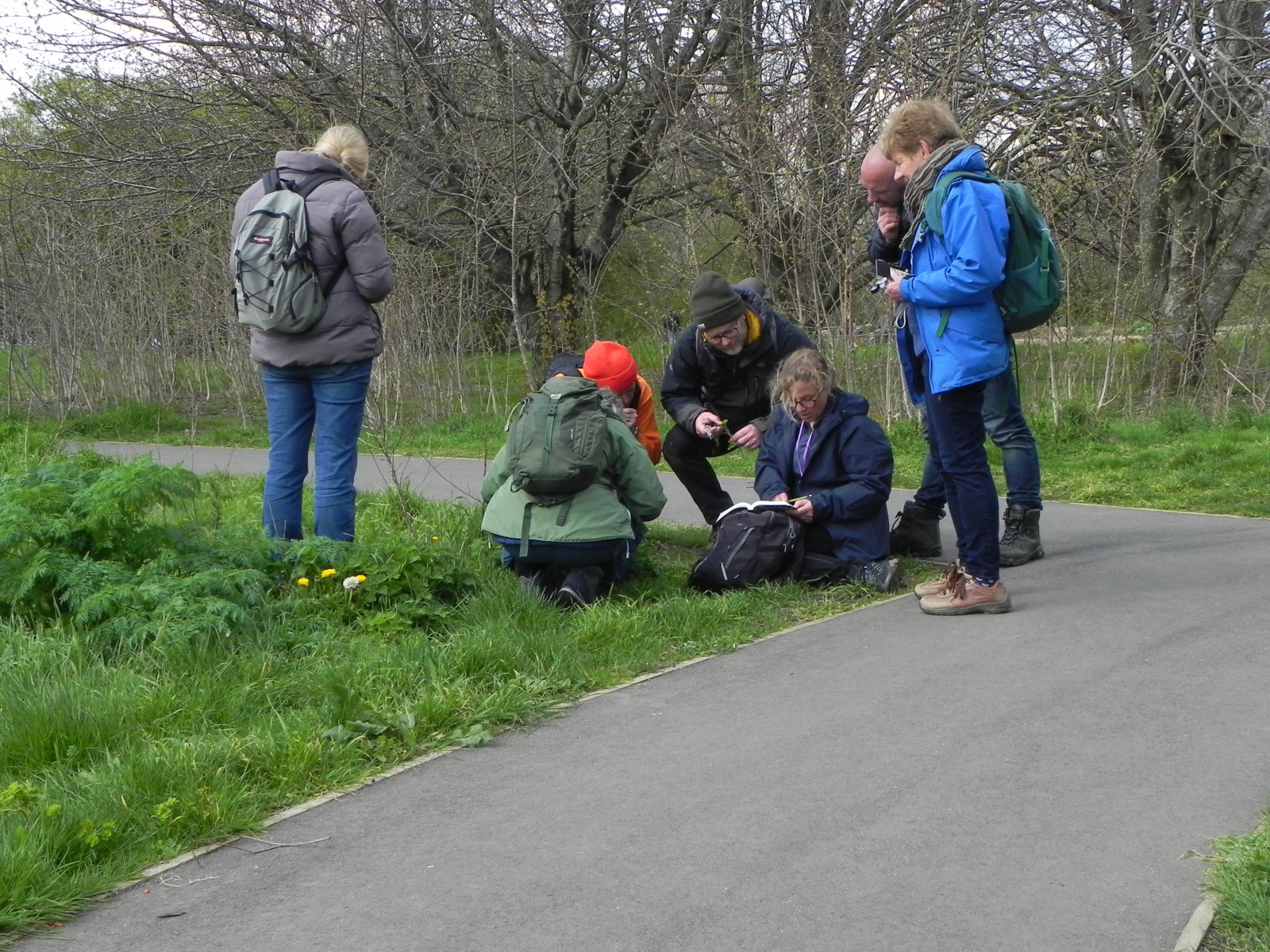
That about covers the morning and we sat down at picnic tables for lunch before attacking the wetter parts of the park. Once again spontaneous units sprang up and I must assume that a great deal of learning took place to judge by the extensive use of keys. Frances was nominated to risk a treacherous pond edge to confirm a long-range determination of Carex acutiformis (Lesser Pond-sedge) and separately there were two studies of some umbellifer leaves which proved to be Sison amomum (Stone Parsley) – the young leaves not bearing the distinctive petrol-and-nutmeg tang of the later flowers and fruit. It was good to see deployment of Poland and Clement’s Vegatative Key to the British Flora (2009) on a range of non-flowering plants and evidently the exercise was greatly enjoyed – there were shouts of jubilation and fist-pumps from Nevil’s band when they tracked down from scratch a mop of softly hairy leaves to Ballota nigra (Black Horehound).
And so eventually to the sea where a modest range of shingle specialists was on show, including the maritime versions of Rumex crispus (Curled Dock) and Solanum dulcamara (Bittersweet). Several non-flowering clovers were puzzled over but only Trifolium micranthum (Slender Trefoil) and T. scabrum (Rough Clover) were prepared to give themselves away. I felt it was a very auspicious start to the field meetings season. In a large turnout we had a good number of new members mixed in with familiar faces, each with their particular skills and all looking critically at plants which for the main part were not yet in flower. The tally of over 140 taxa was arguably more than could be expected so early in the season, especially after an unusually prolonged and cold winter. I should like to thank everyone for contributing to a really excellent day. I do hope you enjoyed it as much as I did!