
Investigations into the response of glassworts to increased levels of salinity
Source: Sturt, Elisabeth. “Investigations into the response of glassworts to increased levels of salinity.” Sussex Botanical Recording Society Newsletter, no. 90 (May 2020). https://www.sussexflora.org.uk/wp-content/uploads/2022/02/Newsletter_may_20.pdf.
In the Autumn of 2018 I carried out a series of experiments on several different species of Glassworts from a site near Bosham in Chichester Harbour to investigate their resistance to different concentrations of salinity by measuring changes in their mass. The strategy involved separate samples of the chosen species placed in a wide range of salinities for the same period of time, their change in mass being recorded and turned into percentage change plus or minus. The graph produced from these results, whilst not entirely smooth, showed that there was a distinct difference in the resistance shown by those species usually to be found in different zones of the shore: Sarcocornia perennis and Salicornia ramosissima were seen to be far more resistant than S. dolichostachya and S. europaea.
The 2018 method adopted by which the specimens were being introduced abruptly to the solution, which in extremes could be as much as 5 molar (5M), obviously had some drawbacks so in 2019 when the Glassworts reappeared I repeated the investigation using an improved technique. To my delight the same trends were seen but a much improved graph of the results was obtained.
In the 2019 experiment single, larger samples of the species (including their roots) were used and they were moved gradually through the range of concentrations starting at 1M and progressing at 8 hour intervals through to 5M. All the specimens shared the same solution in a large washing-up bowl and the solution strength was increased each time by the addition of an appropriate mass of salt. Specimens were weighed wet with only gentle blotting to prevent loss of material. Using a large sample of each species minimised the proportion of experimental error incurred during the blotting and weighing.
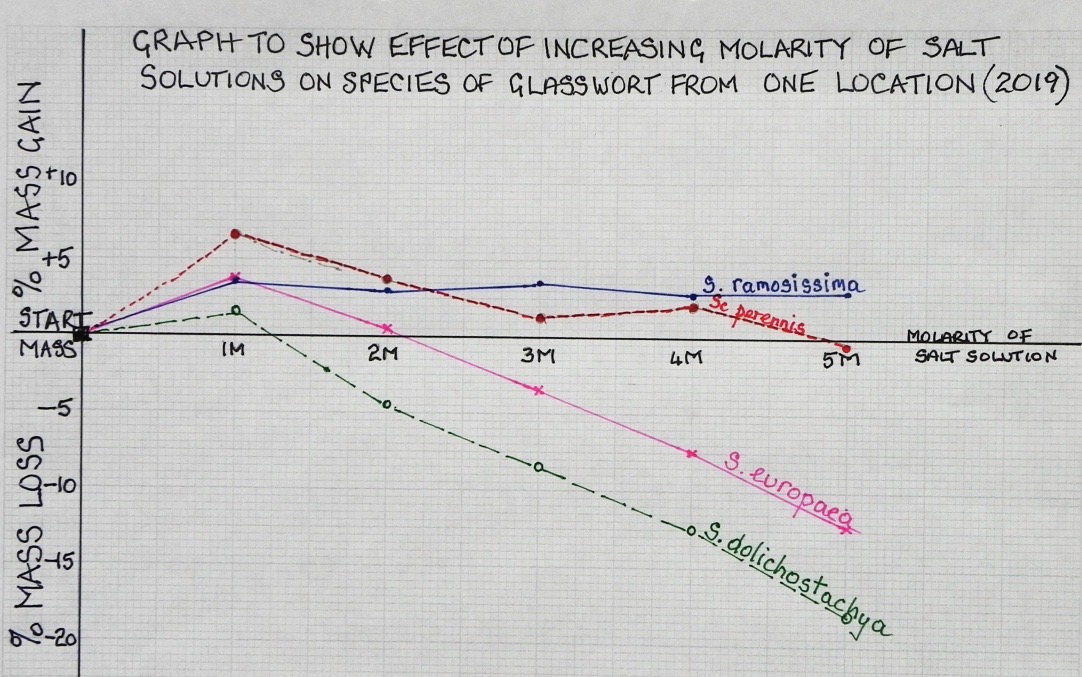
The graph shows very clearly a distinct difference in the responses of the four species of Glasswort. Sarcocornia perennis and Salicornia ramosissima both gained mass and maintained it throughout, whereas S. europaea and S.dolichostachya after an initial gain of mass lost mass fairly quickly and continued to do so. The initial gain in mass by all species is interesting. Normal seawater is approximately 0.6M so even a 1M solution is abnormally strong and most plant cells would lose mass in that situation due to loss of water by osmosis. An increase in mass suggests either that the specimens actively took in salt to enable them to withstand the stress and to avoid losing water from their cells, or that they were already hypertonic to 1M and took on water by osmosis. It seems that as the two resistant species continued actively preventing themselves from losing water it is likely that the former represents the best reason for the initial gain in mass. It was noticeable in handling the two resistant specimens that they were not losing turgidity even by the extreme 5M point. In contrast S. europaea and S. dolichostachya, which both quickly lost mass, were becoming more flaccid during the course of the experiment.
It is tempting to suggest that these contrasting responses reflect the relative positions of these species on the shore as Sarcocornia perennis and Salicornia ramosissima are normally found higher up the shore than the other two. This will result in them receiving longer periods of exposure to the drying effect of the air and the sun before the sea returns, and at the neap tides they could even be exposed for two or three days. Being normally found further down the shore the other two species are more likely to be submerged in sea water twice every 24 hours. Of course it will not only be the aerial parts of the plant that suffer stress because once exposed the effects of the air and temperature will be to cause water to evaporate from the mud and thus the soil solution will become more concentrated; this will have the effect of making it difficult for the roots to absorb water, and thus the plants by actively absorbing minerals, could attempt to maintain a superior osmotic potential and prevent water loss.
[Note: A mole is the SI unit of measurement used to measure the number of molecules of a substance. Molarity is a unit of concentration used in chemistry, measuring the number of moles of a solute per litre of solution. A one molar solution (1M) means there is one mole of substance (in this case salt) per one litre of solute (in this case water), a two molar solution (2M) being two moles of substance per litre, ie twice as concentrated.]