
Interesting Freshwater and Terrestrial Algal Records
Source: Matcham, Howard. “Interesting Freshwater and Terrestrial Algal Records.” Sussex Botanical Recording Society Newsletter, no. 90 (May 2020). https://www.sussexflora.org.uk/wp-content/uploads/2022/02/Newsletter_may_20.pdf.
In Adastra 2018 pp.7-8, I discussed finding the desmid Cosmarium pericymatium Norstedt in an ephemeral pool that had filled with rainwater after a geoarchaeological survey had removed topsoil to a depth of approximately 60cm. Returning in late December 2018 I collected a few specimens of the desmid Penium margaritaceum Brébisson, and sent them to Chris Carter for photomicrographs: the sample was forwarded by him to David Williamson who remarked that he had found a single zygospore, which David subsequently illustrated.
On 10 February 2019 I revisited the site at Maudlin and collected more material which proved to contain an extraordinary number of individuals with zygospores: as far as I can ascertain by perusing numerous literature, zygospores have not been seen from this species in Britain since mentioned by Ralfs in British Desmidiae (1848) p.150, [sporangia] in a collection by the author from Dolgelley and a further collection by a Mr. Thwaites, from Bristol. Unfortunately, dates of these collections are not given but obviously before 1848, the date of publication. Therefore it is possible that zygospores of Penium margaritaceum were last seen in Britain over 171 years ago.

Photo: Dr Chris Carter
As mentioned above, this species and Cosmarium pericymatium were collected from rainwater that had filled shallow depressions left when topsoil had been replaced after a geoarcheological dig carried out prior to the laying of a sewer. The substrate exposed may derive from local Aldingbourne Raised Beach, “This is a marine formation from between c. 400,000 and c. 200,000 years ago – a complex formation which may relate to many different marine incursions. The sand is likely either intertidal, or more likely marine proper.” (E. Blinkhorn, pers. comm.). Ephemeral pools are not the normal habitat for the fairly frequent desmid Penium margaritaceum, which is usually found in Sphagnum bogs. I thank Dr Ed Blinkhorn, Senior Geoarchaeologist, Archaeology South-East, Portslade, Sussex for explaining to me the geology at the site.
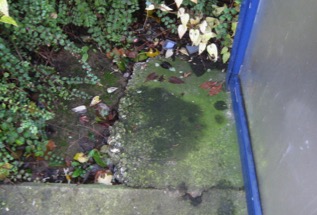
Not having transport we travel to our local supermarket by bus, which can be booked in advance both for pick up at home and return from the supermarket. I had noticed a green covering over damp concrete by the supermarket bus stop where water constantly dripped onto the concrete from the bus shelter roof. The following week I took a sample bottle with me and a small plastic ruler and scraped the algae into the bottle (not a good idea to wander round the supermarket carrying a knife; “I use it to scrape up algae, officer, Heh-Heh. Gulp).”
Under the microscope were numerous filaments of the common alga Microspora amoena var. gracilis, which is found both in aquatic and terrestrial habitats, and intermingled with it were numerous minute unicellular alga approximately 16-26µm in diameter, covered in spines. I puzzled over this species before eventually identifying it as Trochiscia hirta, my identification later confirmed by Professor David John (NHM). The genus in Britain is poorly known and only the four most widespread species are described in The Freshwater Algal Flora of the British Isles (John et al. 2011). T. hirta has not been seen recently as far as I can ascertain, nor has it been imaged previously. I thank Dr Chris Carter for his superb photomicrographs: all four species mentioned can be viewed on www.algaebase.org.
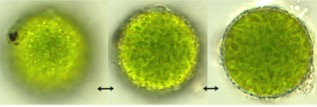
Photo: Dr Chris Carter