
Michael Cadman’s botanical watercolours
Source: Scott, Brad. “Michael Cadman’s botanical watercolours.” Sussex Botanical Recording Society Newsletter, no. 89 (January 2020). https://www.sussexflora.org.uk/wp-content/uploads/2022/02/Newsletter_jan_20.pdf.
Michael Cadman A.R.C.A., R.I. (1920–2010) was a well-known watercolourist who, in the early part of his life, taught at the Epsom School of Art and at Juniper Hall. Exploring the countryside from an early age, in 1956 he started painting wild flowers, an activity that he continued until a few years before his death. Initially living in Surrey, he subsequently resided in Dorset and Cornwall, and in south-west France. Over that time, he produced about 400 studies of plants, which are often in exquisite detail, and richly annotated.
David Streeter first met him in the late 1950s or early 1960s when he was a regular tutor on the Juniper Hall art courses, and they occasionally corresponded until quite soon before Michael Cadman’s death. David notes that “during one of [Cadman’s] Juniper Hall courses he painted a beautiful large watercolour of a bunch of typical chalk downland flowers among which were five or six stems of Bee Orchids which, at the time, didn’t attract anything like the disapproval that it would now evoke.” That painting is still at Juniper Hall.
The earliest works date from the spring of 1956, beginning with familiar plants around Reigate, Oxalis acetosella (Wood-sorrel) and Ficaria verna (Lesser Celandine), and quickly extend further afield on and around the chalk downs, until by the end of the year he had produced about 140 watercolours. At the same time he assembled a collection of about 170 dried plants, stuck into a large bound ledger, many of which are clearly the specimens he painted. This collection of drawings and pressed flowers has not previously been widely known, yet contains many relatively early records for some locations, and also includes details of sites where some species have not otherwise been recorded.
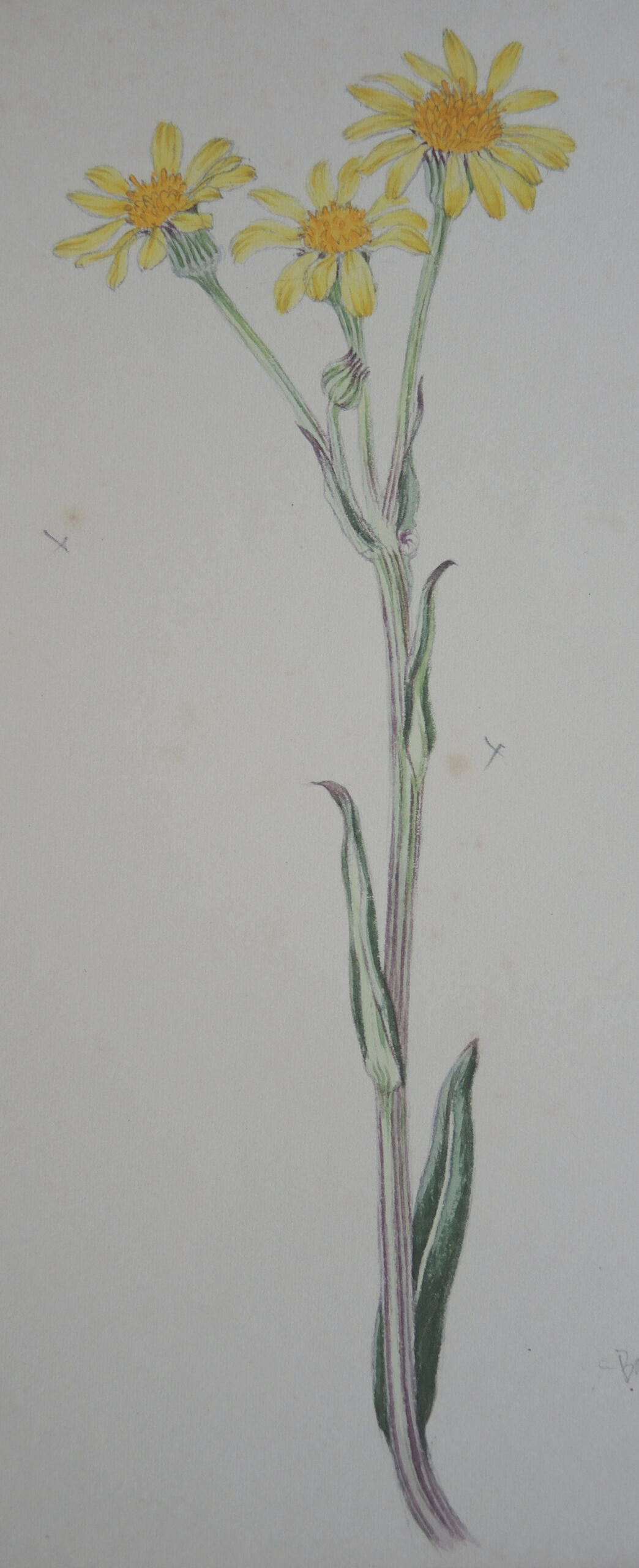
There are only four drawings which are from Sussex plants, the earliest of which Cadman found on 24 March 1957, and is Primula vulgaris (Primrose), though no location is given other than “Sussex”. Two months later, on 19 May, he was back in the county as his drawing of Tephroseris integrifolia (“Field Fleawort (Cambridge Ragwort)”) testifies. This he describes was “Found in short turf on the downs near Seaford, Sussex”, adding one of his characteristic descriptive notes: “Petals ≏ 12–14. Flowers – 4 to 7 in umbel clusters. Leaves long, narrow & pointed, alternate, clasping the stem. Stem leaves and underside of calyces downy. Rosette of leaves at the base.” Among his dried plants, the specimen of Tephroseris integrifolia has no location information written beside it (other than the note “Now Absent from Surrey”), but it is quite clearly the plant in the drawing. It is most likely that this was found in tetrad TV49Z, since it was recorded there in the Sussex Plant Atlas, and Bexhill herbarium has a Seaford specimen from the young Phyllis Stockdale dating from June 1912. However, it was not found in the area during the recording for The Flora of Sussex (2018).
Michael Cadman’s drawing of Phyteuma orbiculare (Round-headed Rampion) illustrates another valuable element of the collection, namely his frequent description of the plant community in which his specimen was found. Exploring the South Downs on 27 July 1961, he collected this iconic Sussex plant, and painted it two days later, recording that it was ‘Found on Sussex chalk (mostly short turf, Ditchling & Lewes, Sussex) in Company with Small Scabious, Self-Heal, Carline Thistle, Eyebright, Common Milkwort, Wild Thyme, Harebell, Common Hawkbit, Red Clover, Bird’sfoot Trefoil. Prolific and Abundant both on grassy slopes, banksides and along pathway borders.’
The final Sussex drawing is of Teucrium scorodonia (Wood Sage) collected 9 September 1965 and ‘Found on chalk downs near Beachy Head (E. Sussex) in longish grass with Carline Thistle, Burnet Rose, brambles, gorse etc’. Again, his artist’s eye for detail further added in pencil a note capturing its ‘Paired leaves at right angles and twin stems from these points (normally only top pair) plus a large central flower-spike. Slightly hairy. Stem and leaf undersides. Very crinkly and minutely-veined leaves’.
It is unsurprising that a professional artist would have painted such high quality illustrations, though they are quite different from most of his commercial works, which often include landscapes and village scenes. Even so, as indicated above, among his watercolours there are some which focus on specific parts of the natural world, both animals and plants, and his notebooks periodically record the birds he saw on his frequent walks. When we look at his botanical paintings we can appreciate that, in a very real sense, his approach to landscape started from the ground up.
Many thanks to Judith Coomber for the loan of the collection. Once it is fully indexed, the details will be shared with the relevant county recorders, and more extensively described before being deposited in a suitable archive.