
Smyrnium olusatrum (Alexanders)
This is the first SxPOTW from the Apiaceae (Carrot) family. There are around 73 species to be found in the UK and the BSBI produced their second handbook to guide you through them. It was written by T.G. Tutin, Clive Stace’s predecessor as Professor of Taxonomy at the University of Leicester, and beautifully illustrated by Ann Davies. The old name for the family is still often used: the umbellifers. This is because the inflorescences (although not always!) are arranged in terminal compound umbels (see the illustration in the link above).
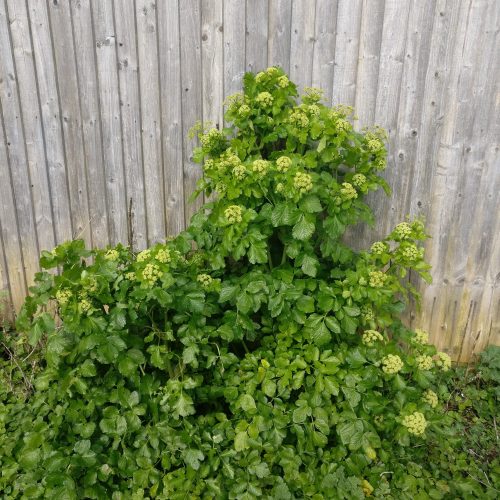
It is an archaeophyte and nearly all texts refer to its introduction by the Romans. It was known to be eaten by them and carried as food on journeys. Certainly it was widely cultivated as a pot herb until the popularisation of celery, which in taste it resembles. Every part of it can be eaten, including the root. The black seeds can be ground and used as an alternative to pepper. It is more commonly found near the coasts, although in Sussex it has spread further inland over the last hundred years, usually as a roadside ‘weed’. This can be seen on the map from our Flora.
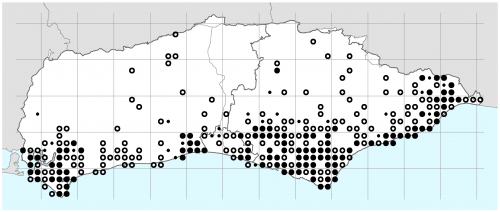
Archaeophyte. Sx: locally common. Roadsides; waste ground; beaches; churchyards. Until at least the late 1930s it was largely a coastal species. W-Dod (1937) regarded it as common and locally abundant along the coast, but knew of only five inland sites. Recording for Hall (1980) showed further inland locations, and this spread has continued, although it still occurs in greatest abundance near the sea. Most inland sites are on road verges. It is thought to have been introduced by the Romans as a potherb.
Source: Smyrnium olusatrum L. Alexanders, The Flora of Sussex (2018)
It always struck me as odd that until the eighteenth century it was more popular than celery given that celery (Apium graveolens) is a native plant. Was it a change in the nation’s tastebuds or was it that it was largely cultivated for medicinal use by people in religious communities? The books tell us that it is still to be found in proximity to long gone medieval establishments such as castles and monasteries, but the name suggests a largely culinary use: olus – a pot herb, atrum – black. And although Smyrna is the old Greek name for the now Turkish town of Izmir, the generic name comes from Pliny who reckoned the plant smelt a bit like myrrh. Its common name comes from it being known as the parsley of Alexandria.
It apparently tastes like angelica (Angelica sylvestris) and has similar leaves, although in herbals it is often referred to as Black Lovage. In Sussex it was known as Megweed. The upper part of the root is the best bit although leaves were often used and in Ireland combined with nettles (Urtica dioica) and watercress (Nasturtium officinale) to make Lenten Potage. According to Geoffrey Grigson, the “young shoots have a pleasant, unusual substance, and a pleasant taste to begin with, though the aftertaste is decidedly bitter and forbidding.” Not exactly a recommendation, however he adds that the old gardening manuals advised blanching the shoots by earthing them up. I’m half-tempted, in this time of pestilence, to give them a try myself: there are some plausible recipes on the interweb.
There is in fact interest in the main essential oil from the plant, Isofuranodiene, as a possible anti-cancer drug and treatment for liver damage. Parkinson, writing in Theatrum Botanicum (1640), advised eating them at the time of Lent to help digest “the crudities and viscous humours [which] are gathered in the stomacke, by the much use of fish at that time.” But perhaps it’s future is as a hangover cure, albeit with some clever marketing?
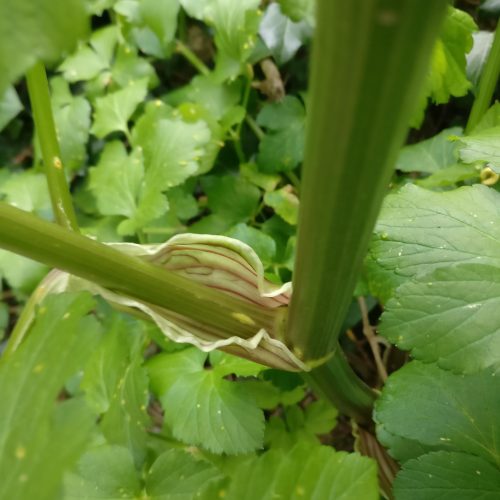
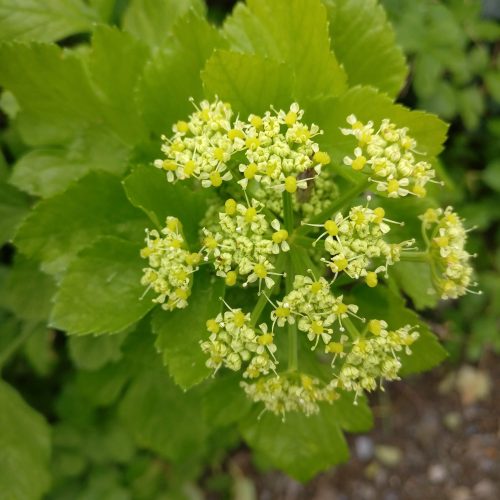
It’s one of the first umbellifers to flower and is easy to recognise. The leaves are dark, glossy green, the lower ones being 2-3 pinnate and the upper ones ternate with hugely inflated petiole sheaths (see photo) which are pink-striped like candy. The flowers are yellow-green with the seeds turning black when ripe.