
Anemone nemorosa (Wood Anemone)

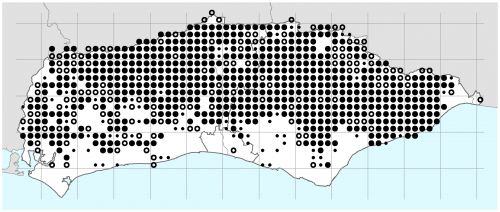
Native. Sx: very common in most areas. Woodland; hedge banks; occasionally in sheltered open areas. An ancient woodland indicator which is scarce only in areas where there is little old woodland, such as the Manhood Peninsula and the eastern Downs. It can be abundant, especially in old coppices. In some Wealden sites it also occurs in old unimproved grassland in sheltered situations, sometimes where bracken checks competing vegetation.
Source: Anemone nemorosa L. Wood Anemone, The Flora of Sussex (2018)
I couldn’t resist this #SxPOTW flower after it was promoted by our friends @wildflowerhour (on Twitter and Instagram, online too with occasional podcasts), nudging me to wander out to some local ancient woodland remnants a couple of weeks ago. It really is a beautiful flower with its light green foliage and bright shining flowers smiling up at you on individual stalks (pedicels). The six to seven ‘petals’ are really ‘tepals’ and are usually white. They can, however, be tinged with pink or purple. There has been a variety with blue flowers (var. caerulea) although this has only been recorded in Cornwall in the last hundred years.
It’s another member of the Ranunculaceae (Buttercup Family), like Ficaria verna (Lesser Celandine), one of our previous #SxPOTW choices. It was known in Sussex by the common folk-name ‘Windflower’, but also as ‘Drops of Snow’. The latter appears to be unique to Sussex. Another name in other areas is ‘Smell-fox’ which apparently derives from its slightly unpleasant smell. I’ve never noticed this but on a still, sunny day I shall definitely be giving them a good nose as well as the eye to smell for myself. (Has anyone noticed this?)
The Windflower epithet comes from the genus name linking to the Greek Anemone, meaning ‘daughter of the wind’. In Greek mythology (probably by way of Summarian) the flowers were formed when the tears of Aphrodite (Venus in Roman mythology) mingled with the blood of her beloved Adonis when he died in her arms after being gored by a wild boar. Seemingly very innocent, but really it’s all about sexual desire. And let’s face it, for much of the animal kingdom, Spring is precisely that time of the year.
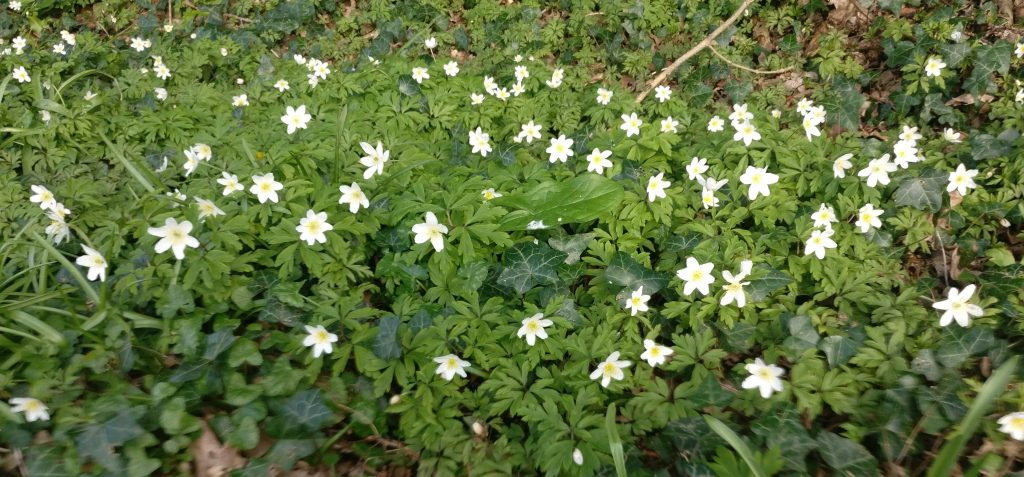
Botanically the plant is interesting because of its inability to colonise quickly. One source suggests it takes a century to spread six feet. It does this through the growth of underground rhizomes as the seeds are seldom fertile and germinate rarely. As a result of this it is one of a suite of plants whose presence indicates that woodland (or hedge-banks, etc.) is ‘ancient’. They are known as Ancient Woodland Indicators (AWIs). The concept arose from the work of the inimitable Oliver Rackham (whose The History of the Countryside is highly recommended!) and was developed most famously by our very own Sussex superhero Francis Rose. If you look in the back of his The Wildflower Key you can see a table of AWIs according to which geographical region of the UK you are in. There are sixty or more for the South-East and include many grasses, sedges and ferns. Its close (but not native) relative, A. apennina (Blue Anemone) is widely planted and occasionally naturalises. I notice that Brighton & Hove have planted hundreds of them in the verges along the Lewes Road. They’re out now and also rather lovely.