
Cochlearia danica (Danish Scurvygrass)
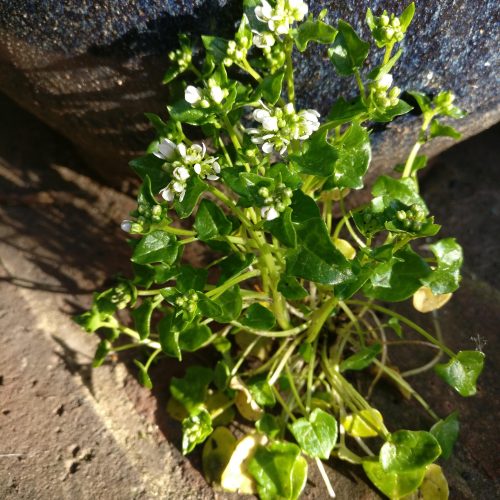
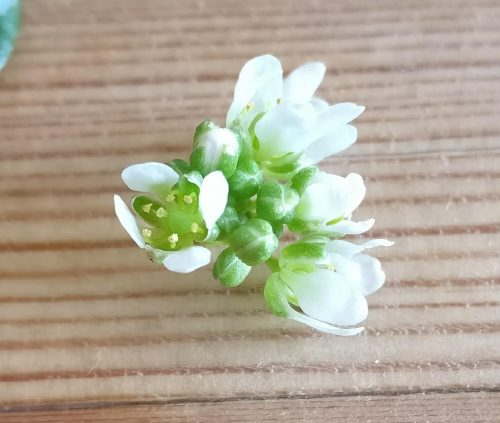
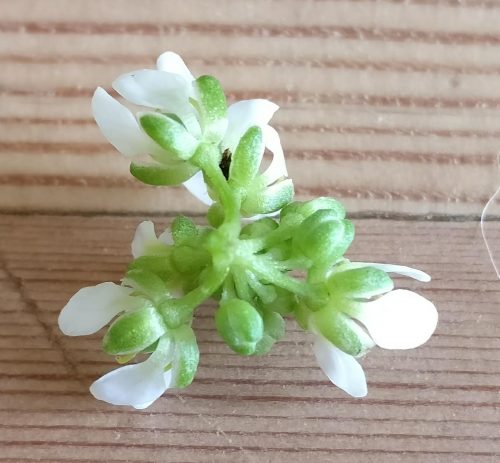
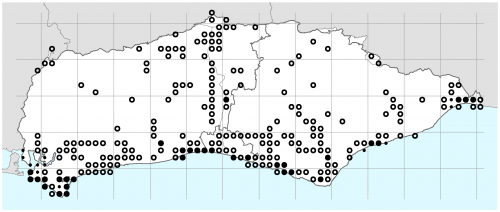
Native. Sx: occasional, locally very common. Sand and shingle beaches; cliffs; coastal pathsides; roadsides. Formerly known only on sandy and shingly foreshores, this species has undergone a great increase in both range and frequency. It is described in W-Dod (1937) as being very local and he gives records from the Chichester Harbour and Pagham Harbour areas, from Shoreham to Aldrington, and near Rye. By the time of the survey for Hall (1980) it had spread a little along the coast in the Brighton area and was reported to be present between Newhaven and Seaford, with an introduced colony at Bexhill and a single inland record in TQ10I. It has now increased considerably along the coast. However, the greatest spread is inland, initially along major roads. It is now present in every tetrad along the A23 and M23, is frequent along many parts of the A27, and is spreading by the A21, A22 and A29. It is also starting to appear on smaller roads. It is sometimes accompanied by other maritime species such as Puccinellia distans and Spergularia marina, but C. danica is the most frequent, and the white roadside fringe can be recorded from a speeding vehicle. This dramatic change is reflected across the country and is associated with the salting of roads in icy weather (Preston et al. 2002).
Source: C. danica L. Danish Scurvygrass, The Flora of Sussex (2018)
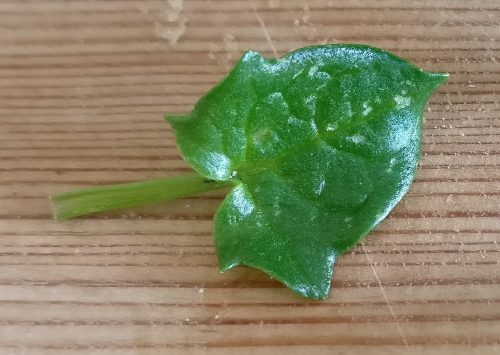
This week’s plant is interesting for a number of reasons. It is our first member of the large family Brassicaceae (Cabbage Family), which are most easily recognised by their flowers. These have four sepals in opposite pairs and four petals alternating with them. There are usually 6 stamens (sometimes 4) and a single-styled ovary with 2 stigmas. The fruit is usually a capsule splitting in half from the bottom up to release the seeds. If you go to this page you will find a wonderful collection of online illustrations at the bottom. Click on any of them to explore the variety of genuses and species. One of my favourites is this one, which nicely illustrates our plant and D. anglica which although closely related, has very different stem leaves.

You can also see from the distribution maps the very different behaviour of the two scurvygrasses. D. anglica is confined to the saltmarsh whereas D. danica is spreading along the roadways. If you look at the map from our Flora the route of the A23/M23 is quite obvious. Despite its name, both plants are natives. A third Cochlearia, C. officinalis is not found in Sussex.
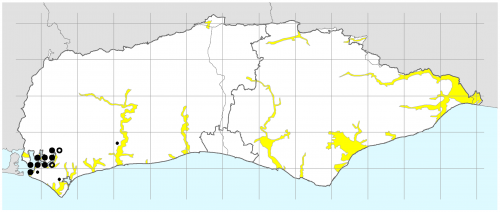
Native. WSx: very locally frequent; ESx: extinct. Saltmarsh, occasionally on sand. The first Sx record was on the beach near Hastings (Petiver 1862 [1714]), but it has long gone from ESx. In WSx it was said in 1784 to be ‘in plenty at Selsey and along the Marshes in Sidlesham Harbour’ (Walpoole 1784): it was last seen in that area in 1990 (SZ89N HH). It is now confined to the margins of Chichester Harbour, where it grows on the upper part of saltmarshes and occasionally on sand, as at East Head. Hall (1980) shows an inland tetrad (TQ00D), now thought to be in error for C. danica. In the BI it is locally frequent on coasts but rare in the SE, and Chichester Harbour now represents the eastern extremity of its distribution along the south coast of England, although it reappears in the Thames Estuary.
Source: Cochlearia anglica L. English Scurvygrass, The Flora of Sussex (2018)
Although I haven’t dwelt on family characteristics until now it is worth doing so for brassicas. They are a very large group and there are plenty of little critters that aren’t always easy to recognise. For this reason, the lovely people at BSBI have produced one of their special handbooks for them. It’s by the excellent Tim Rich, who also has helpful plant identification videos on YouTube. Furthermore, if you buy from Summerfield books and are a member of BSBI, you get a discount. Furthermore, it is, at the time of writing, in a sale and as cheap as you’re ever likely to get it! Knowing which family a plant is in makes identification much much easier.
So the place to look for it is on the roadside edge of verges. The reason is that it is a halophyte, and the repeated application of salt to our main roads has altered the habitat to create an artificial strip of ‘saltmarsh’. When it is fully out in flower you can even spot it from the car as you are driven along (you have to be on the passenger’s side usually, although you may see it growing on the central reservation when stuck in a traffic jam) as it forms white patches or strips.
Its common name derives from its Vitamin C content. Scurvy is caused from vitamin C deficiency and although rarely seen these days it was a scourge of sailors before the end of the eighteenth century. When you consider that as a folk remedy its effectiveness against the condition was known for centuries, it seems odd that it took the navy so long to sort it out. Gerard writes extensively of its benefits. It was commonly grown in physic gardens, but usually C. officinalis as this was easier to propagate. (The specific name officinalis is the epithet of the officina, the shop (referring to the apothecary’s shop), wherein medicinal plants could be bought. Many other plants carry it in their binomial.)
When botany got going, it was speculated that Scurvy-grass was the herba Britannica of the ancients, including Dioscorides. Pliny reports that Roman legionaries fighting across the Rhine were taught by the Frisians about a herb that treated a condition with symptoms remarkably like those of scurvy.