
Primula vulgaris (Primrose)

They’re out and about in shaded but sunny and a bit damp places near you now; another ‘spring classic’ whose common name derives from the Latin for ‘first rose’ and whose binomial derives from ‘first’ and ‘common’. It even has its own family – the Primulaceae – which includes Hottonia (represented by H. palustris (Water-violet)) and Lysimachia (which has recently expanded to include the Anagalis (as in Scarlet Pimpernel), Glaux (as in Sea-milkwort) and Centunculus (as in Chaffweed) genuses).
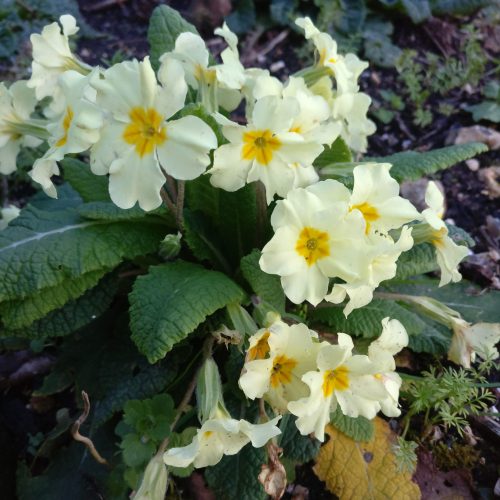
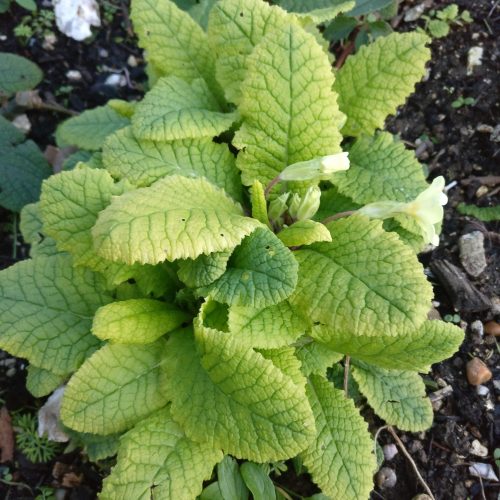
Although the actinomorphic yellow flowers usually appear singly on their petioles, they can occur in umbels (var. caulescens). They also arise in a wide range of colours and structural forms.
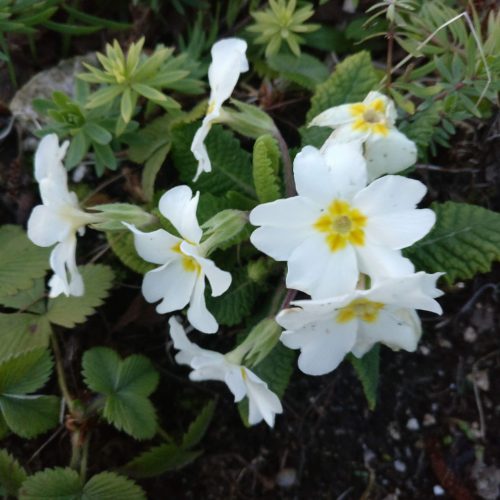
Their close relative, P. veris (Cowslip), appears later in the year and on more basic soils. Look at the difference in distribution in our Flora maps:

Native. Sx: abundant.
Source: Primula vulgaris Huds. Primrose, The Flora of Sussex (2018)
Woodland; hedgebanks; road verges and other shaded grassland. Most frequent on heavier soils. It has become less abundant within some woods where coppicing has ceased and the ground is no longer periodically flooded with light, but it usually survives on margins and by rides. An ancient woodland indicator when well within woods and not apparently planted. The introduced ssp. rubra (Sm.) Arcang. was recorded as a garden escape in 1998 from the disused railway at Southwater (TQ12S AGH).
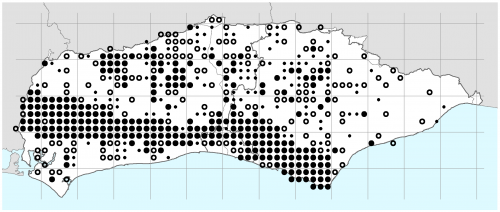
Native. Sx: frequent, locally abundant.
Source: P. veris L. Cowslip, The Flora of Sussex (2018)
Grassland. A species of unimproved grassland which is common and in places abundant in short species-rich chalk turf on the Downs. It is also fairly widespread across the Weald, sometimes still in old meadows and pastures on base-rich clay soils. However, it is now more frequent there on road verges and in marginal habitats since much species-rich grassland has been lost to cultivation, neglect or agricultural improvement. It frequently occurs in churchyards and on verges near houses and has probably been planted in many of these locations. Some churchyards support old unimproved grassland where it is a likely native. In recent years it has been planted in numerous grassland restoration and creation schemes, obscuring its native distribution. The map probably includes a number of introduced populations.
Primroses are heterostylous. This means some flowers have long styles (so-called ‘pin’ flowers) with the anthers found half way along the corolla tube, while others have short styles (so-called ‘thrum’ flowers) with the anthers arranged around the top of the corolla tube. The pollen grains differ between the two also, along with the size of the ovules and number of seeds produced (fewer in ‘pin’ plants). For plants to set good quantities of seed, pollen from a thrum plant must fertilise pin plants and vice versa.
A third form can also be found, but not in all populations. In this the style is long and the anthers are at the top of the corolla tube: they are known as long-homostyle flowers. This third form is not found in all populations and I confess to not knowing if they are found in Sussex. (Answers on a postcard or digital equivalent.) These plants are self-fertile and do not require moths for pollination, unlike the heterostylous forms.
There remains even now a lack of understanding about this common plant: theoretically the reproductive advantage of long-homostyle plants should lead to it out-competing the heterostylous plants. This is not the case. (Answers in a PhD or equivalent.)
Charles Darwin was the first to appreciate the significance of the morphological difference and eventually wrote a book on the subject of floral morphological variation. There is an excellent summary of the history of the science of Primula variation for those who’d like to explore it further. Distribution of the species and its forms is still a matter for scientific study, with many exceptions to general rules.
Primrose picking used to be widespread, with blooms sent from rural areas to the cities in prodigious quantities. During the 1970s when picking wild flowers was beginning to be discouraged, a number of studies tried to assess the impact on local populations. One such study in Devon looked at the effect of the collection of up to 1.3 million blooms annually from a small district and could find not obvious deleterious effects. (Although it should be added that as the plants live for 15 -25 years, a greater longitudinal study might have been necessary to demonstrate this.)
Did you know that 19 April is Primrose Day? It was started in 1881 by Sir George Birdwood to commemorate the death of Benjamin Disraeli, who was passionate about the primrose.