
Ficaria verna (Lesser Celandine)

Most people would recognise this as a sort of buttercup, and they’d be right. Until recently it was known as Ranunculus ficaria and the Ranunculaceae is the Buttercup Family. It was known in the past as Figwort or Pilewort because of the similarity of the tubers of the plant with the medical condition (‘Fig’ was a synonym: cf. Common Figwort). Sufferers of the latter may beg to question the link, but to the herbalists of the past the Doctrine of Signatures was a great marketing ploy.

As for the common name, it comes from the Greek chelidon for a swallow. This is odd, because the swallow arrives long after the flowering of the plant. According to Richard Mabey (Flora Britannica p48) it may have arisen through confusion with the other celandine, Greater Celandine Chelidonium majus. This plant is in the Papaveraceae or Poppy Family, so totally unrelated to Ficaria verna. The latter was believed to be used by swallows to restore the sight of their young. It’s sometimes easy to mock the beliefs of the past, but in this case it doesn’t seem unreasonable.
Wordsworth was something of a fan of Ficaria verna and included them in a few of his poems. Like most people, he strongly associated the flowers with the arrival of spring. It was supposed to be one of the flowers carved on the monument to him in St Oswald’s Church, Grasmere. But botanical ignorance struck again: it’s the Greater Celandine that appears in the bottom right of the memorial!
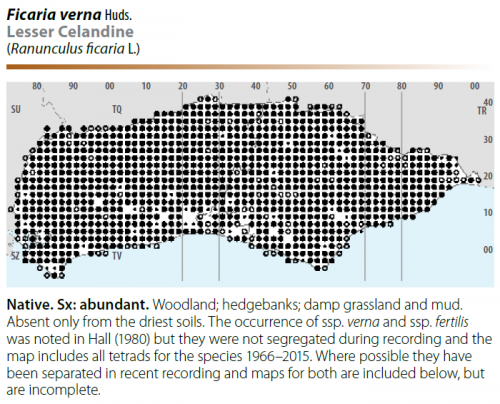
Ficaria verna is a plant of shady places, often damp in winter. Woods, hedgebanks, streamsides, damp meadows and lawns, avoiding very dry or acid soils. There are two native subspecies, ssp. fertilis and ssp. verna. Both are common throughout the UK but often poorly recorded to the subspecies level. This is because to tell them apart you have to wait until after flowering (anthesis) to look at the head of achenes and the presence or absence of axillary bulbils. F. verna ssp. fertilis reliably produces seed but has no bulbils, the opposite is true of F. verna ssp. verna. The former is diploid (2n=16), the latter tetraploid (2n=32).

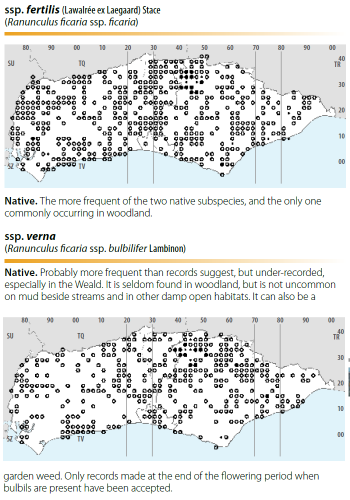
There are two other subspecies in Stace but they are thought to be garden escapes. So look out for these little harbingers of spring. Around Lewes some flower from the beginning of January. Gilbert White noted in his The Natural History of Selborne that the average date for first flowering was 21 February, but then that was before the Industrial Revolution.